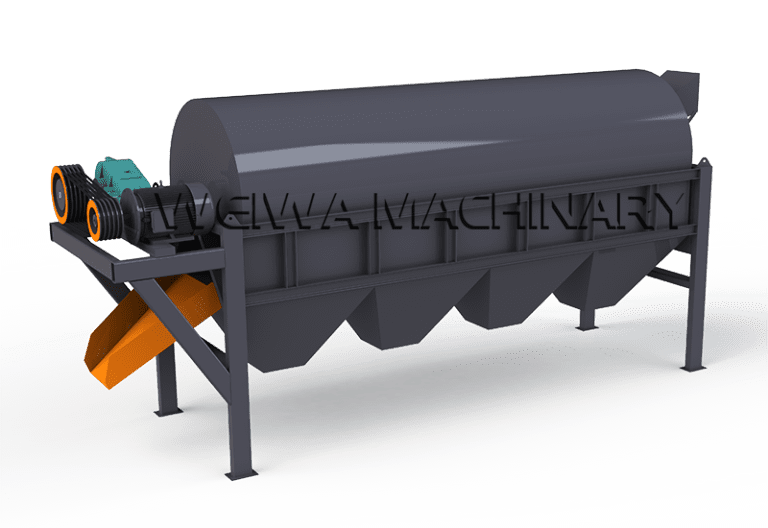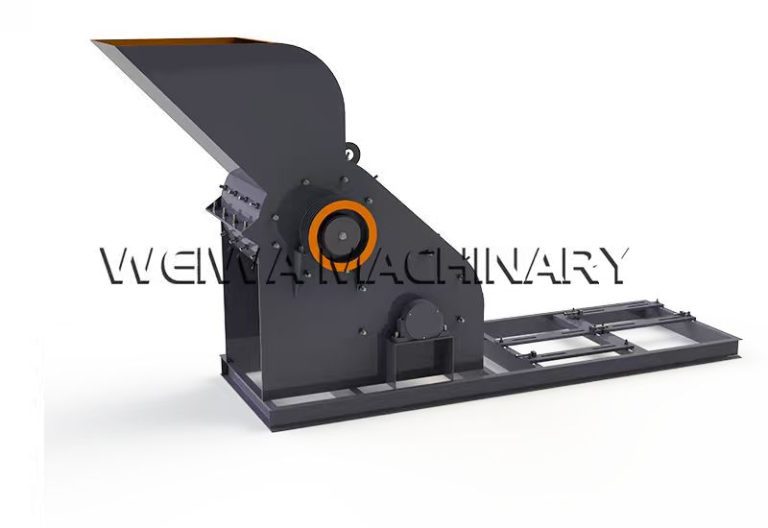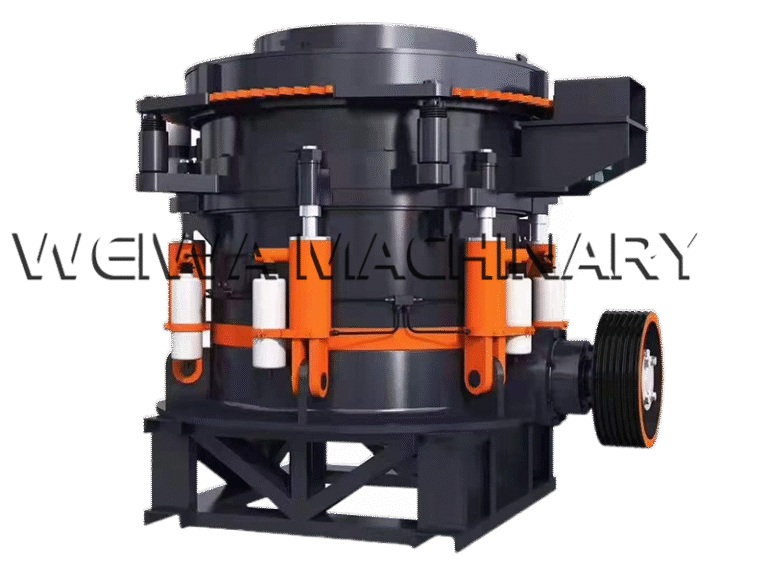
When Ghanaian mining operators and quarry managers look for dependable material classification equipment, the rotary screen—also known as a drum screen or trommel screen—consistently emerges as a practical choice for alluvial gold washing plants, aggregate classification yards, and recycled material recovery sites. At Weiwa Machinery, we have spent more than thirty years designing, manufacturing, and exporting heavy-duty rotary screens to global markets including West Africa. Over the past decade, we have supplied multiple rotary screen units to gold wash plants in the Ashanti and Western Regions of Ghana as well as to crushed stone producers near Accra and Kumasi.
What Is a Rotary Screen and How Does It Work?
A rotary screen, sometimes referred to as a roller screen or drum screen, is a cylindrical screening device mounted on a frame at a slight incline—usually between five and twelve degrees from horizontal. The drum is fabricated from perforated steel plate or fitted with woven wire mesh panels of specified aperture size. An electric motor coupled with a reduction gearbox or a chain drive rotates the drum at low speed, typically between eight and twenty revolutions per minute depending on drum diameter and application.
Bulk material is fed into the elevated end of the rotating drum either directly from a hopper, a belt conveyor, or a vibrating feeder. As the drum rotates, the material is lifted along the inner wall by friction and then cascades downward under gravity—a tumbling action that constantly exposes new material surfaces to the screen openings. Particles smaller than the mesh aperture fall through the screen and are collected in an undersize hopper or chute beneath the drum, while oversized material continues traveling axially along the inclined drum until it discharges from the lower end.
Unlike high-frequency vibrating screens that rely on aggressive oscillation to stratify dry, cubical aggregate, the rotary screen relies on gentle tumbling. This makes it especially effective for materials that are sticky, contain fines, or tend to blind vibrating decks—conditions commonly encountered in Ghana’s placer gold fields where lateritic clay and moist sand can clog conventional screens.
The rotary screen we manufacture at Weiwa Machinery can be configured with single or multiple screen sections, each having a different aperture size, allowing simultaneous production of two or three sized fractions in one pass. For alluvial gold applications in Ghana, we frequently integrate high-pressure water spray bars inside the drum to scrub clay off the gold-bearing gravels while screening, which greatly improves both washing efficiency and downstream recovery rates.
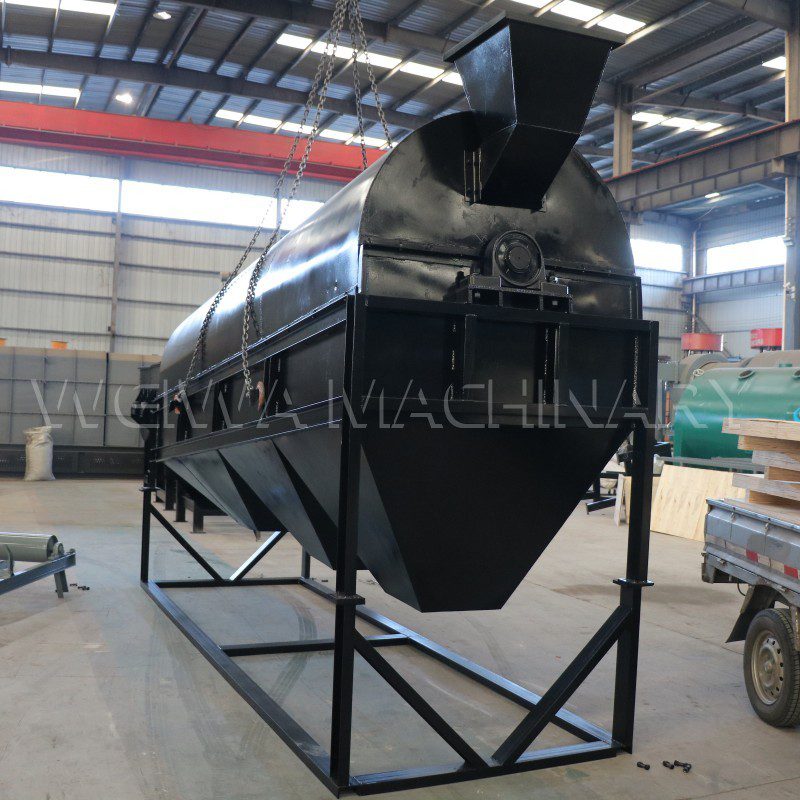
Why the Rotary Screen Is Well Suited to Ghana’s Mining and Quarrying Conditions?
Ghana is one of Africa’s leading gold producers, with a substantial portion of output coming from small- to medium-scale alluvial and shallow lode mining operations. The country also has an active construction aggregates sector supplying crushed stone, river sand, and gravel to infrastructure projects in Accra, Kumasi, Tamale, and Sekondi-Takoradi. Both industries face recurring material handling challenges that a properly specified rotary screen can address.
Alluvial gold deposits in Ghana’s Birimian greenstone belts and along river valleys such as the Offin, Ankobra, and Pra often contain cohesive clay, laterite, and vegetation remnants. When dry-season material is excavated after rain or from below the water table, the ore becomes a sticky mixture of fine silt and coarse gravel. Vibrating screens frequently suffer mesh blinding under such conditions, requiring frequent manual cleaning and causing bottlenecks. A rotary screen with internal water sprays and a slightly coarser primary punched plate can break up clay lumps during tumbling and keep the outer screening mesh clear, maintaining continuous throughput.
In the quarry sector, Ghanaian aggregate producers sometimes process weathered or moisture-laden stone, especially during the rainy season from April through October. Even modest moisture content can cause fine particles to agglomerate on vibrating decks. The open tumbling action in a rotary drum naturally de-agglomerates such material, while the large open area ratio of punched plate drums promotes efficient passage of correctly sized fines.
Furthermore, many Ghanaian mining sites operate with limited access to sophisticated maintenance crews or spare parts inventories. The rotary screen’s mechanical simplicity—a rotating drum supported on trunnion rollers or a tyre-and-trunnion system, driven through a single reduction gear—means fewer wearing parts in motion compared to multi-deck vibrating screens with eccentric blocks, springs, and linkages. Routine maintenance typically involves greasing bearings, inspecting the drive chain or belt, and occasional screen panel replacement, tasks that can be carried out with basic tools.
Power supply considerations are also important. Weiwa rotary screens destined for Ghana are commonly wired for 380–415 V, 50 Hz three-phase supply, compatible with most industrial power setups in Ghana, and we can equip units with direct-on-line starters or variable frequency drives when clients wish to fine-tune drum speed for different feed characteristics.
Comparison Between Rotary Screen and Vibrating Screen in Ghana Applications
Understanding when to choose a rotary screen instead of a vibrating screen helps Ghanaian buyers make cost-effective decisions. Vibrating screens excel at high-speed sizing of dry, pre-crushed, cubical rock in closed-circuit crushing plants where precise cut-point control and high G-force stratification are required. They occupy less footprint per ton of throughput and can achieve very accurate size separation on dry material.
By contrast, the rotary screen is the preferred option when the feed contains clay, moisture, or a wide size distribution including sticky fines; when the plant requires combined washing and screening; or when the operator prefers lower noise, reduced structural vibration, and simpler mechanics. In a typical Ghana alluvial gold wash plant, a rotary screen serves as both scrubber and primary classifier, feeding the minus-6 mm or minus-10 mm fraction to sluice boxes, jigs, or centrifugal concentrators while rejecting oversize boulders and roots. For a quarry producing sub-base material from weathered rock, a rotary screen can scalp off the minus-20 mm fraction with fewer stoppages due to blinding.
It is worth noting that rotary screens generally have a larger footprint than equivalent-capacity vibrating screens and may consume marginally more floor space, but this trade-off is often justified by reduced downtime and the elimination of daily screen deck brushing on sticky feeds.
Rotary Screen Components and Customization Options from Weiwa Machinery
Weiwa Machinery rotary screens are engineered with a modular design philosophy so that each unit can be adapted to the client’s specific material type, required capacity, and site constraints. The main components include the feed hopper or chute, the rotating drum assembly, the support frame with trunnion rollers, the drive system comprising motor, reducer, and coupling, the discharge chutes for oversize and undersize streams, and an optional spray bar system for wet screening.
The drum itself is constructed from heavy-gauge carbon steel with longitudinal stiffeners to prevent ovality under load. For abrasive applications such as iron ore or granite screenings, we apply wear-resistant liners at the feed-end section where impact is highest. Screen openings are produced either by CNC-punched steel plate—preferred for primary scalping and clay-rich ores—or by bolted wedge-wire or woven mesh panels for secondary sizing. Multiple segments with different aperture sizes can be installed in sequence along the drum length, enabling production of, for example, a coarse reject oversize, a mid-size fraction, and a fine undersize in a single machine.
The inclination angle of the drum is adjustable on some models via pivot feet on the support frame, allowing operators to slow down or speed up material residence time. Slower drum speeds with steeper angles retain material longer for more thorough washing, whereas shallower angles with slightly higher RPM promote faster throughput when screening relatively clean, dry aggregate.
For coastal or high-humidity installations in Ghana where corrosion is a concern, we offer hot-dip galvanized frames, epoxy-coated exterior surfaces, and stainless-steel contact parts for the undersize chute. Drive motors are available in IP55 or IP65 protection classes with tropical-rated winding insulation to withstand high ambient temperatures and dust.
Mobility is another consideration. Several Ghanaian gold mining contractors requested wheel-mounted or skid-mounted rotary screens so that the washing plant can be relocated as the pit face advances. Weiwa Machinery supplies both stationary and mobile rotary screen configurations, the latter complete with integrated diesel generator set, folding discharge conveyors, and lighting mast for night operation.
Typical Technical Parameters of Weiwa Rotary Screens
While each rotary screen is tailored to order, the following ranges illustrate common specifications for units exported to West African mining markets. Drum diameters span from 800 mm for small-scale alluvial plants processing 5–15 tons per hour up to 2,000 mm diameter for industrial quarries handling 150–250 tons per hour. Drum lengths are typically two to four times the diameter to ensure adequate retention time. Drive power ranges from 4 kW on compact units to 30 kW on the largest heavy-duty drums. Aperture sizes are fully customizable from 3 mm fine mesh to 100 mm punch plate. Infield testing with Ghanaian alluvial ore, our GT-series rotary screens routinely achieve screening efficiencies above ninety percent on the designated cut size when properly matched to feed gradation.
On-Site Trial and Performance Feedback from Ghanaian Clients
To validate the suitability of our rotary screens for Ghana conditions, Weiwa Machinery conducted equipment trials with two representative customers—a placer gold mining company operating near Dunkwa-on-Offin in the Central Region and a crushed stone producer serving road contractors in the Eastern Region close to Koforidua.
The gold mining client had previously used a static grizzly combined with manual hand-screening for washing alluvial material. Their main pain points were frequent clogging of the grizzly bars by clay lumps, loss of fine gold-bearing material due to inadequate washing, and the labor intensity of manually breaking up clay balls. We installed a Weiwa GT1225 rotary screen with 10 mm × 20 mm slotted punch plate as the primary section and 5 mm woven mesh as the secondary section, plus four rows of high-pressure spray nozzles fed from a 5.5 kW water pump drawing from the nearby stream.
During the seven-day trial, the plant processed approximately 900 tons of alluvial overburden with clay content visually estimated at fifteen to twenty-five percent by weight. The rotary screen maintained continuous operation without manual unclogging, something the previous grizzly could not achieve beyond two hours without intervention. Gold concentrate yield, as measured by the client’s existing sluice recovery system, increased by an estimated eighteen percent compared to the same ore zone processed the previous month, attributed to more complete liberation of fines from clay matrices and the absence of oversized material bypassing the sluice boxes. The client noted that oversize rejection was cleaner, with virtually no gold-bearing fine sand reporting to the reject pile, and that the washed oversize rocks were sufficiently clean for immediate discard.
The quarry client’s challenge was seasonal blinding of their double-deck vibrating screen when processing weathered granitic material during the rainy season. Throughput would drop from a rated 120 tons per hour to below 70 tons per hour within a morning shift as the 6 mm bottom deck blinded with damp fines. We replaced the vibrating screen’s bottom deck with a standalone Weiwa GT1540 rotary screen in a closed-circuit configuration with their existing jaw crusher. Although the rotary screen occupied more linear floor space, the plant’s effective hourly output stabilized at 105–115 tons per hour regardless of moisture fluctuation, and the maintenance team reported a sixty percent reduction in time spent clearing blocked screen cloth. Bearing temperature and drive current remained within specification throughout the three-week evaluation, and the quarry superintendent commented favorably on the noticeably lower noise level compared to the previous high-frequency vibrating deck.
These field experiences reinforce that when the rotary screen is correctly sized—taking into account feed particle size distribution, maximum anticipated clay content, desired cut point, and required tons-per-hour throughput—it delivers reliable performance in Ghana’s real-world operating environments.
How to Select the Right Rotary Screen for Your Ghana Operation?
Choosing an appropriately specified rotary screen prevents under-capacity issues on one hand and unnecessary capital expenditure on the other. Weiwa Machinery engineers follow a structured consultation process with prospective Ghanaian buyers, typically requesting the following information before proposing a configuration.
First, provide a representative sample or at minimum a description of the material to be screened: whether it is alluvial gold ore, crushed stone, sand, recycled concrete, or another bulk solid. Indicate the expected particle size range of the feed—for instance 0–150 mm—and note any unusual characteristics such as high plasticity index clay, fibrous roots, or sharp angular fragments. Moisture content estimates, even approximate seasonal highs and lows, help determine whether a wet-drum configuration with spray bars is advisable.
Second, specify your target cut size or sizes. A common request from Ghana gold wash plants is to separate at 6 mm or 10 mm, sending the minus fraction for gravity concentration and rejecting plus material. Quarry operations may require scalping at 30 mm or 40 mm with a secondary split at 5 mm or 10 mm. Knowing the required undersize percentage and the acceptable oversize contamination tolerance lets us calculate the necessary screen open area and drum length.
Third, state the design throughput in tons per hour under normal operating conditions, and whether the plant expects surge loading from frontend loaders or a steady belt-fed regime. This determines drum diameter, rotational speed, and drive power. As a rule of thumb, increasing drum diameter improves capacity more efficiently than lengthening the drum, but excessive diameter may pose transport clearance issues on Ghana’s inland roads—something we account for by offering sectional drum designs that bolt together on site.
Fourth, communicate site constraints: available foundation space, single-phase versus three-phase power availability, whether the unit should be skid-mounted for relocation, preferred control voltage, and ambient conditions such as coastal salt spray or red dust prevalence. These inputs guide our recommendations on motor enclosure, paint system, and structural bracing.
Finally, consider after-sales support. Weiwa Machinery maintains spare parts kits for all rotating screen models exported to Africa and can advise on the minimum recommended inventory of items such as trunnion roller bearings, drive belts or chains, and screen panels. We also provide operation and maintenance manuals in English, commissioning guidance via video call, and on-site technician dispatch for larger turnkey projects.
Installation and Commissioning Tips for Rotary Screens in Ghana
Proper installation is critical to achieving the designed screening performance and prolonging equipment life. The foundation should be level, compacted, and capable of supporting the static and dynamic loads of the rotary screen—typically a reinforced concrete pad or steel channel sleepers bolted to concrete footings. Ensure the support frame is shimmed so that the drum axis is parallel to the intended incline and that both trunnion roller sets are coplanar; misalignment causes uneven tyre wear and can overstress the drive.
Check that the rotation direction matches the arrow on the drive guard before coupling the motor. For wet screening units, verify that the water supply pressure and flow rate meet the spray bar design requirement—usually 2 to 3 bar at the manifold for effective clay scrubbing without excessive splash-over. During initial commissioning, run the empty drum to confirm smooth rotation, absence of abnormal noise, and correct amperage draw, then introduce a partial feed load and observe material flow patterns through the inspection ports.
Periodic inspection of the screen panels for wear or punctured mesh is advised, particularly when processing abrasive granite or quartzitic ore. Replace worn panels promptly to avoid undersized material contaminating the oversize stream. Grease the trunnion and drive bearings according to the schedule in the manual—typically every 250 operating hours for standard applications.
Frequently Asked Questions About Rotary Screens for Ghana Buyers
Many first-time buyers in Ghana ask whether a rotary screen can handle large boulders mixed with alluvial gold ore. The answer is yes, provided the drum inlet diameter is sized to admit the maximum expected boulder size—usually we allow at least 1.5 times the top-size rock dimension as a rule of thumb—and the primary section uses a robust punched plate rather than delicate mesh. Boulders simply tumble through the drum and discharge at the tail without damaging the finer screening sections downstream.
Another common question concerns capacity versus vibrating screen. A rotary screen of comparable footprint will typically handle lower maximum throughput than a multi-deck banana screen on dry, free-flowing stone, but in the presence of clay, moisture, or washing requirements the rotary screen’s effective available runtime is far greater because it rarely blinds. The net weekly tonnage processed is often equal to or better than a vibrating screen that requires frequent stoppage for cleaning.
Buyers also ask about mobility. Our skid-mounted rotary screens can be loaded onto a low-bed trailer and transported between mining leases; modular drum sections allow disassembly for access to remote sites with narrow tracks. For fully mobile wash plants we offer container-sized frames integrating hopper, rotary screen, and discharge conveyor in one unit.
Why Choose Weiwa Machinery as Your Rotary Screen Supplier?
Weiwa Machinery is a specialist manufacturer of mineral processing and material handling equipment with more than thirty years of engineering heritage. Our rotary screens are in daily operation across Africa, Southeast Asia, and the Americas—screening gold ore, tin, coal, aggregates, compost, and industrial minerals. Each machine is fabricated in our ISO-certified workshop, hydro-tested for spray systems, and run under no-load before shipment.
For Ghanaian clients we provide English-language documentation, assistance with customs documentation, and guidance on local agent liaison where applicable. Our customer service team is available twenty-four hours a day to respond to inquiries, and we can arrange partial shipments of wear parts to minimize downtime. Whether you need a compact 10 tph trommel for a small placer claim or a 200 tph heavy-duty drum screen for a commercial quarry, Weiwa Machinery engineers a solution matched to your material and your market.
About Weiwa Machinery
Weiwa Mining Machinery (Weiwa Machinery) is a global supplier of complete flowsheet solutions for mineral processing, construction, recycling, agriculture, and cement production. With over 30 years of manufacturing experience and products exported to more than 120 countries and regions, we serve 2,000,000+ customers worldwide. Our product range includes jaw crushers, hammer crushers, rotary screens (roller screens/drum screens/trommel screens), ball mills, conveyors, and customized crushing & screening plants.
- Email: [email protected]
- Phone/WhatsApp: +86 18439853888
- Address: Dahuangye Industrial Zone, Gongyi City, Henan Province, China
Contact Weiwa Machinery today to request the latest rotary screen specification sheet, quotation, or a customized solution for your Ghana gold mining or quarry project.