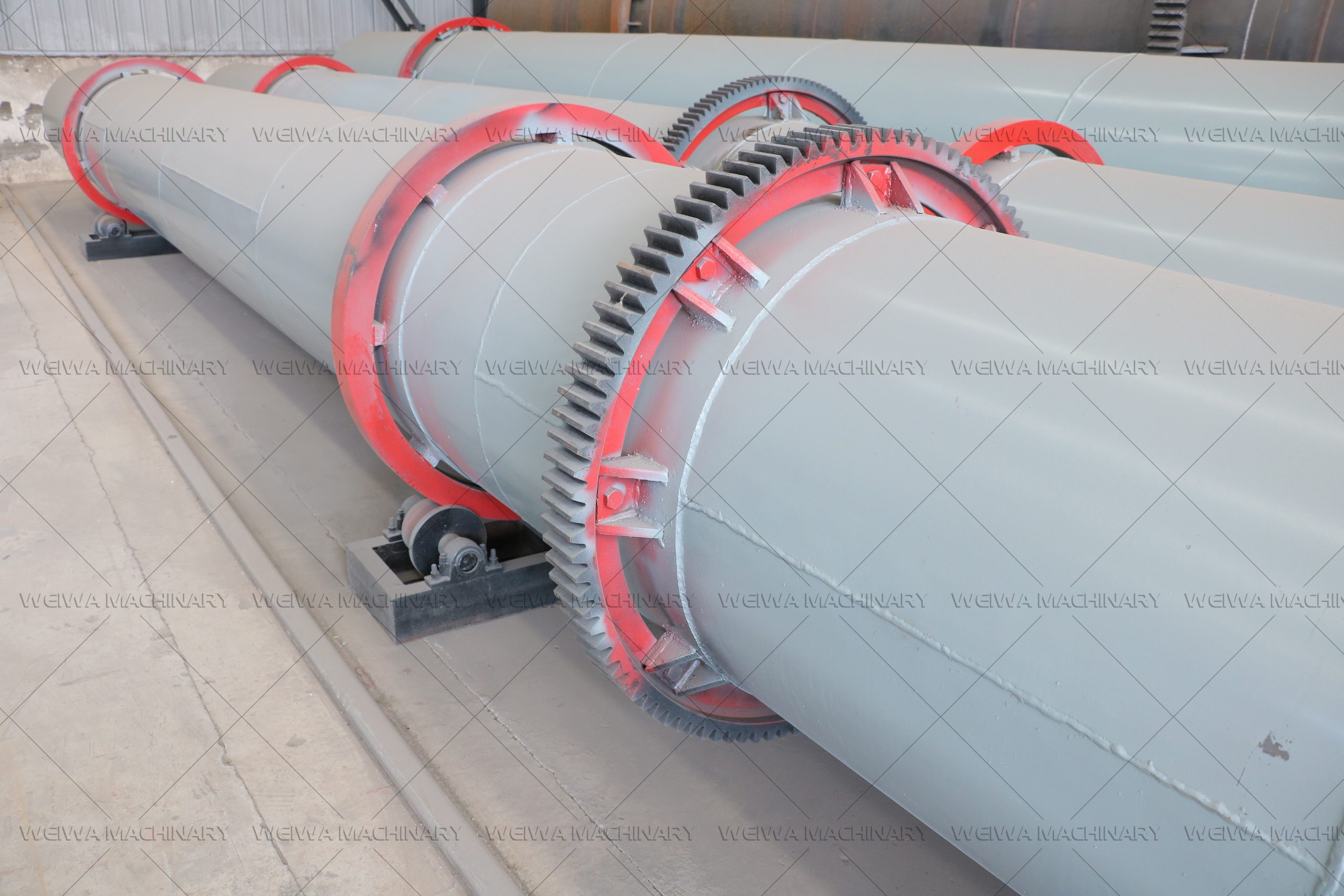
A rotary dryer, also commonly referred to in industrial contexts as a tumble dryer, is the backbone of continuous bulk material moisture removal across Australian mineral processing plants, silica sand washing lines, fertilizer factories, and large-scale grain handling facilities. At Weiwa Machinery, we have spent more than thirty years engineering heavy-duty rotary dryer systems that are now operating reliably in Queensland, New South Wales, Western Australia, and Victoria.
Why the Rotary Dryer Is the First Choice for Australian Industry
Australia is rich in silica sand, iron ore, bauxite, limestone, coal, and agricultural produce such as wheat, barley, and canola. Each of these materials leaves the mine, quarry, or field with residual surface or bound moisture that must be reduced before further processing, safe storage, or cost-efficient export shipment. A rotary dryer or tumble dryer handles this task through a continuously rotating inclined drum in which hot gases transfer heat by convection while internal flights lift and cascade the material for maximum exposure. Unlike batch-type ovens, a well-designed rotary dryer can process thousands of tons per day with stable discharge moisture, which is exactly what Australian aggregate producers and bulk export terminals require.
The Australian summer introduces extreme ambient temperatures while winter in the southern states brings humidity that slows natural sun-drying of sand or grain. Our tumble dryer installations are engineered with modulating burners and exhaust exhaust temperature feedback loops so that the outlet moisture stays within specification regardless of seasonal variation. Whether the heat source is natural gas, diesel, biomass, or waste-heat recovery from a nearby kiln, Weiwa rotary dryer systems adapt to local fuel availability across Australian job sites.
Key Applications of the Rotary Dryer and Tumble Dryer Across Australia
Drying Silica Sand and Construction Sand for Australian Glass and Concrete Plants
Silica sand mined mined in New South Wales and South Australia often carries five to fifteen percent free moisture after washing. For glass manufacturing or dry-mix mortar production, final moisture typically must be below one percent. A rotary dryer configured with a counter-current airflow pattern and stainless or manganese steel flights produces evenly dried sand without overheating the quartz particles. Several Australian sand plants have integrated our tumble dryer upstream of screening and bagging lines, reporting consistent moisture control and reduced clogging in downstream conveyors.
Iron Ore Concentrate and Mineral Drying in Western Australian Mines
In Pilbara-type operations, filtered iron ore concentrate may still carry eight to eighteen percent moisture. Shipping moist ore increases freight cost and complicates rail transport. A heavy-duty indirect or direct rotary dryer reduces moisture to below five percent, enabling safer stockpiling and lower logistics expense. Our Australian trial unit processed one hundred fifty tons per hour of iron ore tailings, lowering moisture from eighteen percent to four point eight percent within forty-eight hours of commissioning. Site engineers noted that the tumble dryer drum alignment remained stable under continuous twenty-four-hour operation and that the integrated multi-cyclone dust collector kept visible emissions well within typical environmental thresholds.
Agricultural Grain and Fertilizer Drying for Australian Farms and Blending Stations
Wheat, sorghum, pulses, and oilseeds harvested during wet seasons require immediate reduction of kernel moisture to prevent mould growth in silos. Similarly, granulated NPK or organic fertilizers must be dried before coating and bagging. The gentle tumbling action inside a rotary dryer minimizes breakage of delicate seeds while still achieving thorough evaporation. For organic fertilizer producers in regional Australia, our tumble dryer fitted with a biomass-fired furnace allows low-cost drying using locally sourced wood chips or rice hulls, supporting both sustainability goals and operating budget constraints.
Biomass Wood Chip and Sawdust Drying for Australian Bioenergy Projects
With growing investment in renewable energy, Australian pellet mills increasingly rely on rotary dryer systems to precondition wood chips and sawdust. High initial moisture—sometimes above fifty percent—is brought down to ten to twelve percent suitable for pelleting. Our tumble dryer drums drums for biomass applications use deep-flight designs to retain longer residence time without excessive length, an important consideration on compact Australian plant footprints.
On-Site Trial and Commissioning Results for an Australian Client
Weiwa Machinery recently supervised dispatched a complete rotary dryer system to an Australian aggregates and sand processing client for a pre-shipment factory acceptance test followed by on-site commissioning. The objective was to dry washed silica sand from an initial moisture of eleven percent to a guaranteed final moisture below 0.8percent at a rated capacity of sixty tons per hour.
During the trial phase in our workshop, we simulated Australian ambient conditions using variable inlet air temperatures between six hundred and seven hundred eighty degrees Celsius depending on feed moisture. The tumble dryer drum slope was set at three degrees with rotational rotation speed of three point five revolutions per minute. Internal lifting flights were arranged in a double-shower configuration to maximize sand cascading. After parameter optimization, the system consistently delivered sand at 65percent final moisture.
On-site in Australia, the customer connected the rotary dryer to an existing natural gas burner and a baghouse dust collector. Start-up took less than one shift. Within two days of fine-tuning damper positions and drum speed, the plant achieved stable operation at the target throughput. The site manager reported that compared with their previous drying method—sun drying on paved pads—the Weiwa tumble dryer eliminated weather dependency, reduced moisture variability from plus or minus three percent down to plus or minus 0.3 percent, and freed up valuable yard space previously used for spreading wet sand. Transportation costs dropped noticeably because each truckload carried more saleable dry product and less water weight.
Design Features That Make Weiwa Rotary Dryer and Tumble Dryer Suitable for Australia
Every rotary dryer we manufacture for the Australian market is engineered with several region-specific considerations. The drum shell is fabricated uses high-strength boiler steel plate with wear-resistant lining where abrasive ores are processed. Riding rings and thrust rollers are oversized to extend service intervals under continuous duty. Sealing systems at both ends minimize cold air infiltration, which is critical when aiming for high thermal efficiency in large-throughput Australian plants.
Our tumble dryer control panel supports PLC-based auto-regulation of inlet temperature, induced draft fan frequency, and discharge belt speed. This allows Australian operators to compensate for fluctuating feed moisture—common after rain events—without manual intervention. Optional remote monitoring enables Weiwa engineers in China to assist with diagnostics, reducing downtime for overseas customers.
For dusty applications such as dry sand or fine mineral concentrates, we pair the rotary dryer with a primary cyclone separator followed by a bag filter or wet scrubber depending on local EPA requirements. Australian states have differing emission regulations; our engineering team reviews project location in advance and sizes the dust collection train accordingly.
How to Select the Right Rotary Dryer or Tumble Dryer Model for Your Australian Operation?
Choosing the correct rotary dryer size and configuration depends on multiple variables: material type, particle size distribution, initial versus target moisture, required hourly capacity, allowable fuel type, ambient temperature range, and available plant footprint. Submitting a representative sample to our test laboratory allows us to determine the evaporation rate curve and recommend drum diameter, length, flight geometry, and heat source rating. For most Australian silica sand or aggregate drying lines, drum diameters from one point two meters to three point two meters with lengths of eight to twenty-eight meters cover typical needs, but custom dimensions are available.
When you inquire about a tumble dryer for Australia, please provide the above data along with your preferred fuel option. Weiwa Machinery will return a proposal including process flow diagram, foundation drawing, power and fuel consumption estimates, and spare parts recommendation list. We also offer supervision of installation and operator training either on-site in Australia or via detailed video guidance prior to dispatch.
About Weiwa Machinery
Weiwa Machinery is a leading manufacturer of industrial crushing, screening, and drying equipment with over thirty years of experience supplying more than one hundred twenty countries. Our product range includes jaw crushers, impact crushers, cone crushers, vibrating screens, sand washers, ball mills as well as complete rotary dryer and tumble dryer systems for mining, construction, chemical, and agricultural applications. All equipment is produced under strict ISO-quality control, tested before shipment, and backed by a global spare parts and technical support network.
If you are evaluating a rotary dryer in Australia or a tumble dryer in Australia and need a reliable partner for design, supply, and after-sales service, contact our team today.
Email: [email protected]
Phone / WhatsApp: +86 18439853888
Address: Dahuangye Industrial Zone, Gongyi City, Henan Province, China