In the rapidly evolving industrial landscape of India, material classification and size-based separation have become central to productivity, waste reduction, and product quality across mining, construction, agriculture, recycling, and food processing sectors. A rotary screen has emerged as one of the most reliable, low-maintenance, and high-throughput solutions for bulk material handling in these industries. At Weiwa Machinery, with more than 30 years of engineering expertise and a growing footprint across more than 120 countries, we have closely studied the operational challenges faced by Indian clients and refined our rotary screen in India deployments to deliver measurable performance improvements.
Understanding the Rotary Screen and Its Working Principle
A rotary screen, also widely referred to as a drum screen or trommel screen, is a mechanical separation device that classifies materials based on particle size using a slowly rotating inclined cylindrical drum. Unlike high-frequency vibrating screens that rely on aggressive oscillation, a rotary screen uses a gentle tumbling action as material moves from the elevated feed end toward the discharge end due to gravity and drum rotation. Perforations or mesh openings on the drum wall allow undersized particles to pass through, while oversized materials continue along the drum length and exit at the lower end. This mechanism makes the rotary screen particularly suitable for fragile, abrasive, sticky, or high-moisture materials commonly encountered in Indian mining and recycling sites.
The operational simplicity of a rotary screen contributes to its durability and reduced downtime. Driven by an electric motor coupled with a gearbox or chain drive, the drum rotates at low to moderate speed, typically between 10 and 25 revolutions per minute depending on diameter, inclination angle, and material characteristics. The inclination angle, usually ranging from 2 to 8 degrees, is optimized during engineering to balance retention time and throughput. Inside the drum, lifter bars or helical flights may be added to improve material turnover and prevent blinding of the apertures. At Weiwa Machinery, every rotary screen in India we supply is configured after analyzing feed size distribution, moisture content, bulk density, abrasiveness, and required separation cut points to ensure the equipment performs reliably under local site conditions.
Key Components of a Weiwa Rotary Screen
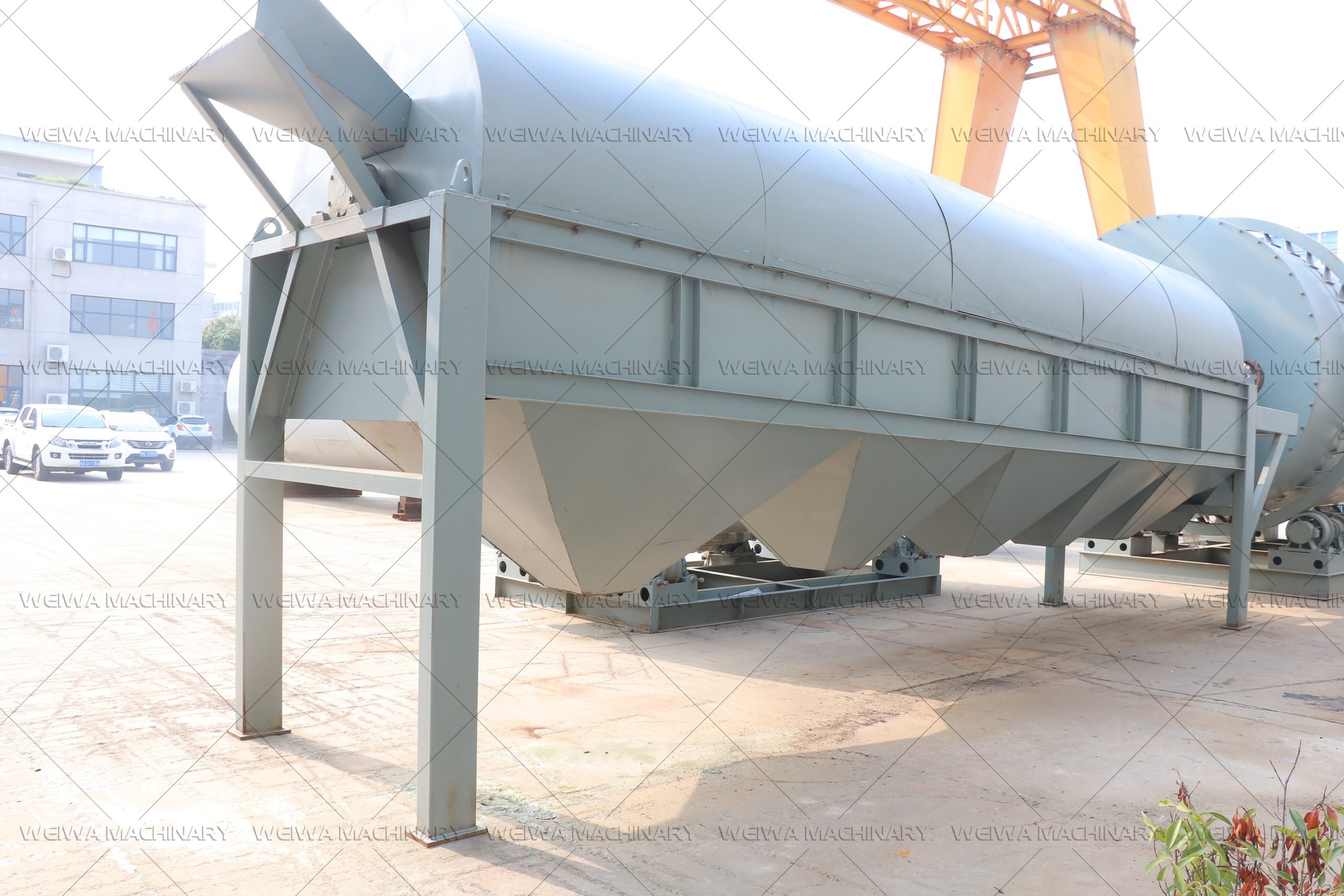
The structural integrity of a rotary screen begins with the drum shell, which is fabricated from high-manganese steel, stainless steel, or carbon steel depending on the application. For abrasive Indian iron ore or granite quarry operations, we recommend high-manganese or wear-resistant alloy drums. For food-grade or corrosive environments such as spice processing or fertilizer plants, stainless steel 304 or 316 drums are engineered. Supporting the drum are heavy-duty rolling rings and tire assemblies mounted on fixed or adjustable trunnion rollers that absorb radial and axial loads. The drive system is selected based on torque requirements, with slip-ring motors or variable frequency drives offered for energy-efficient control. Sealed bearing housings, centralized lubrication points, and modular screen panels simplify maintenance, a critical factor for rotary screen for India installations where onsite technical resources may be limited.
Feed chutes are lined with replaceable wear plates to extend service life, while discharge outlets are partitioned to collect multiple size fractions when multi-deck or multi-aperture configurations are used. In India’s monsoon-prone regions, where moisture content in sand, coal, or construction debris can rise significantly, Weiwa rotary screen in India units often integrate dewatering sections, anti-clogging perforation geometry, and internal brush or spray systems to maintain screening efficiency. These region-specific adaptations are the result of extensive field trials and customer feedback collected across states such as Odisha, Rajasthan, Tamil Nadu, Maharashtra, and Karnataka.
Why Rotary Screens Are Gaining Traction in the Indian Market?
India’s industrial sectors are characterized by extreme diversity in raw materials, climate variability, and infrastructure constraints. In mining belts such as those in Eastern and Southern India, operators frequently process iron ore, coal, limestone, and bauxite with high fines content and seasonal moisture. Traditional vibrating screens often suffer from blinding, high noise, excessive vibration transmission to structures, and accelerated wear under such conditions. A rotary screen addresses many of these pain points by offering continuous tumbling separation with fewer moving parts and lower dynamic loads. This has driven growing interest in rotary screen in India across both large enterprises and small-to-medium processing plants.
In the construction and demolition recycling sector, Indian regulations and sustainability initiatives are pushing contractors to recover aggregates, sand, and fines from demolished concrete and masonry. A rotary screen for India’s recycling yards must handle irregular feed with nails, rebar fragments, plastics, and wood while maintaining throughput. The drum’s rotational movement naturally orients elongated debris and reduces the risk of mesh blockage compared to planar vibrating decks. Similarly, in agriculture and food processing—major contributors to India’s economy—grading grains, pulses, seeds, spices, sugar, and tea leaves requires gentle handling to prevent breakage. The low-impact motion of a rotary screen preserves product integrity while achieving uniform size classification, making it a preferred choice for exporters aiming to meet international quality standards.
Regional Demand Patterns Across India
In Western India, particularly Gujarat and Maharashtra, rotary screen in India demand is closely tied to stone crushing clusters, ceramic raw material preparation, and spice processing hubs. Plants in these regions often operate multiple shifts and value equipment that can run uninterrupted for extended periods. Weiwa Machinery has supported several clients near Ahmedabad and Surat with customized drum lengths and perforation patterns to match high-throughput requirements. In Northern India, including Rajasthan and Uttar Pradesh, mining of marble slurry, quartz, and aggregate drives adoption. Here, dust suppression and abrasion resistance are prioritized, and our rotary screen for India designs incorporate enclosed drum sections, dust seals, and hardened screen plates.
Southern India presents a mix of granite quarrying in Andhra Pradesh and Tamil Nadu, coconut shell and coir processing in Kerala, and mineral beneficiation in Karnataka. The coastal humidity and occasional heavy rainfall necessitate corrosion protection and moisture-handling features. Eastern India, with its dense concentration of coal and iron ore operations in Jharkhand, Odisha, and Chhattisgarh, benefits from heavy-duty rotary screen models with reinforced trunnions and high-capacity drive trains. Across all these regions, Weiwa Machinery’s approach has been to treat each rotary screen in India deployment as an engineering project rather than a commodity sale, ensuring that trial outcomes translate into long-term operational gains.
Technical Considerations When Selecting a Rotary Screen for India
Choosing the right rotary screen begins with a clear understanding of material characteristics. Particle size distribution is fundamental: the proportion of near-size particles strongly influences aperture selection and screening efficiency. In Indian coal washeries, for example, a significant fraction often lies close to the 10 mm or 15 mm cut point, requiring precise perforation sizing and drum speed tuning. Moisture content is equally critical. Materials above 6–8% surface moisture tend to stick to screen surfaces, reducing effective open area. Weiwa addresses this in rotary screen for India applications by offering slotted perforations, tapered holes, internal agitation flights, and optional water spray systems for washing and dewatering simultaneously.
Throughput targets must be balanced against retention time. A rotary screen that is too short may not provide sufficient tumbling cycles for accurate separation, while an excessively long drum increases footprint and capital cost. Drum diameter also affects stratification: larger diameters allow deeper material beds but require higher driving torque. Inclination angle adjustments, sometimes made variable on-site, help fine-tune residence time. Weiwa engineers typically run simulation-based calculations and pilot trials before finalizing specifications for any rotary screen in India project, ensuring that rated capacity accounts for realistic feed variability rather than ideal laboratory conditions.
Abrasion Resistance and Material of Construction
Indian mining feeds are often highly abrasive, especially iron ore fines, quartz, and granite chips. A standard carbon steel drum may experience rapid perforation wear, leading to product contamination and frequent shutdowns. Weiwa rotary screen builds for such environments use rolled high-manganese steel plates with hardness ratings above 500 HB in critical zones. Screen panels can be designed as replaceable segments rather than integral drum shells, reducing long-term maintenance costs. For moderately abrasive or non-corrosive applications such as municipal solid waste screening, galvanized or painted carbon steel suffices. In food and pharma contexts—growing niches for rotary screen for India—mirror-finish stainless steel with polished welds ensures hygiene compliance and easy cleaning.
Bearing selection and sealing deserve special attention in India’s dusty or coastal sites. Spherical roller bearings with labyrinth seals or triple-lip contact seals protect against ingress of fine powder and moisture. Trunnion rollers are machined to tight tolerances and set with adjustable bases to compensate for wear over time. Drive systems are enclosed in weatherproof housings, and control panels are equipped with overload protection, ammeter indicators, and optional remote monitoring interfaces. These details may seem incremental, but during a rotary screen in India trial run lasting 30 to 90 days, they often determine whether the equipment meets availability targets above 95%.
Trial Run Methodology and Performance Evaluation by Weiwa Machinery
At Weiwa Machinery, every rotary screen for India deployment begins with a structured trial protocol. Prior to shipment, shop testing is conducted at our Gongyi facility using surrogate materials mimicking the client’s expected feed. Once onsite, installation is supervised by our technicians who verify foundation alignment, drive train concentricity, and electrical integration. The trial run is divided into three phases: commissioning, performance validation, and stress testing. During commissioning, no-load rotation checks bearing temperatures, vibration levels, and noise. A rotary screen operating correctly typically shows bearing temperatures stabilizing below 65°C after two hours and noise levels between 60 and 70 dB at one meter, significantly quieter than comparable vibrating screens.
Performance validation introduces actual feed at incremental rates—first at 50% of design throughput, then 75%, and finally 100–110%. Key metrics recorded include screening efficiency, undersize passage rate, oversize rejection accuracy, throughput stability, and power consumption per ton. Screening efficiency is calculated as the ratio of correctly separated material to total target fraction in the feed. In multiple rotary screen in India trials, Weiwa units have consistently achieved efficiencies between 85% and 95% depending on cut size and feed nature. For instance, in an Odisha iron ore application with 8% moisture and a 15 mm cut point, our trial rotary screen reduced material loss from 12% to below 3% within the first week of tuning drum speed and inclination.
Observed Trial Run Improvements Across Indian Sites
In a Rajasthan stone aggregate plant, the client previously used a double-deck vibrating screen that required weekly mesh changes and suffered frequent motor coupling failures. After installing a Weiwa rotary screen for India with a 2.2 m diameter and 6 m long drum, the trial run over 45 days showed a 37% increase in daily throughput, from 800 to approximately 1,095 tons, while maintenance interventions dropped by 60%. Blinding incidents during humid mornings were eliminated by switching to tapered perforations and adding intermittent brush scrapers. The plant manager noted that the rotary screen’s stable rotational movement reduced foundation cracks that had plagued the previous vibrating equipment.
In a Maharashtra spice processing facility, a food-grade stainless steel rotary screen in India was trialed for grading turmeric and chili powders. The gentle tumbling action prevented particle breakage that previously downgraded export quality. Sieve blinding due to oily residues was mitigated by ultrasonic-assisted cleaning integrated into the drum section, a customization developed by Weiwa for Indian spice exporters. Over a 30-day trial, product acceptance rates by international buyers improved by 20%, directly attributable to uniform particle size distribution achieved by the rotary screen. Similar positive outcomes have been documented in Tamil Nadu coir mills, Karnataka granite quarries, and West Bengal municipal waste sorting facilities, reinforcing the adaptability of the rotary screen for India across sectors.
Comparative Advantages Over Vibrating Screens in Indian Conditions
While vibrating screens remain prevalent, the rotary screen offers distinct advantages in several Indian operational contexts. First, the dynamic forces generated by a rotary screen are largely balanced due to uniform rotation, minimizing transmitted vibration to supporting structures. This is valuable in India where many plants operate in shared industrial sheds or on light foundations. Second, the tumbling action handles sticky or high-fines materials better than linear or circular vibrating decks, which are prone to near-size pegging. Third, noise reduction is substantial: field measurements during rotary screen in India trials routinely show 15–20 dB lower noise than equivalent-capacity vibrating screens, improving compliance with workplace safety norms.
Maintenance complexity also differs. A rotary screen has fewer eccentric mechanisms, no high-stroke bearings subject to impact loading, and wears more uniformly across the drum surface. Modular screen panels on Weiwa units allow section-wise replacement rather than full drum rebuilds. For remote Indian sites with limited access to specialized maintenance crews, this simplicity translates to higher equipment availability. Energy consumption per processed ton is often comparable or lower for rotary screen for India configurations because the drum rotates slowly and does not fight inertial reversal cycles typical of high-frequency vibrators. These cumulative benefits explain why more Indian operators are transitioning portions of their screening circuits to rotary screen-based systems supplied by Weiwa Machinery.
Limitation Awareness and Engineering Trade-offs
It is important to acknowledge that a rotary screen is not a universal replacement for all screening tasks. For very fine separations below 3–5 mm, especially in dry applications, vibrating screens or gyratory sifters may achieve higher accuracy in certain cases. Drum diameter and length must increase substantially to maintain efficiency at very fine cuts, which affects footprint and cost. Weiwa Machinery transparently discusses these trade-offs during rotary screen in India consultations, often proposing hybrid flowsheets where a rotary screen handles primary and secondary scalping while a fine vibrating deck manages the final cut. This engineered compromise maximizes overall plant efficiency and aligns with capital budgeting realities common among Indian mid-sized processors.
Another consideration is elevation requirement. Because a rotary screen is inclined, feed must typically be lifted to the higher end, which may need conveyors or hoppers with sufficient height. In retrofit projects across India, Weiwa engineers evaluate existing plant layout constraints and design compact rotary screen for India units with optimized slope and integrated feed chutes to minimize civil modifications. Such site-specific engineering is a cornerstone of our trial-success rate and differentiates a globally experienced manufacturer from generic equipment suppliers.
Customization and Localization by Weiwa Machinery for Indian Clients
Weiwa Machinery’s philosophy for the Indian market is rooted in localization without compromising engineering standards. Every rotary screen in India we deliver is preceded by a technical audit covering material samples, site photos, power availability, ambient conditions, and maintenance preferences. Based on this, we produce detailed general arrangement drawings, foundation load diagrams, and electrical schematics. Drum perforation patterns are CNC-cut and verified against calibrated gauges. Drive packages are selected from globally recognized brands with local Indian service networks to ensure spare availability. Control panels are wired with tropicalized components rated for high ambient temperatures and voltage fluctuations common in parts of India.
To support rotary screen for India operators, Weiwa maintains documentation in English with clear maintenance schedules, lubrication charts, and troubleshooting flowcharts. Onsite training covers safe startup, emergency stop procedures, screen panel replacement, bearing inspection, and basic alignment checks. For clients in major cities such as Mumbai, Delhi, Chennai, Kolkata, Hyderabad, Ahmedabad, and Bangalore, we coordinate with logistics partners to stock critical spares including trunnion rollers, bearing housings, drive couplings, and screen segments. This after-sales ecosystem is vital because a rotary screen is only as reliable as the support structure behind it, especially in a geographically vast market like India.
Case-Based Insights from Indian Industrial Segments
In the mining sector, a rotary screen in India deployed for iron ore scalping upstream of crushers protects downstream equipment from oversize and reduces recirculation loads. Trial data from an Odisha site indicated a 40% improvement in crusher throughput after introducing a Weiwa rotary screen with 25 mm apertures ahead of the primary jaw crusher. In coal handling, especially in Washery and CHP circuits, rotary screen for India applications have demonstrated stable separation at 6 mm and 13 mm cuts even with 7–9% surface moisture, whereas vibrating ban screens required frequent roping and washdowns.
In construction demolition recycling, a rotary screen installed in Pune processed mixed demolition debris at 120 tons per hour, segregating fines below 10 mm for brick manufacturing and oversize above 40 mm for secondary crushing. The drum’s ability to tolerate irregular feed without abrupt shock loads extended component life. Agricultural applications in Punjab and Haryana saw rotary screen in India units grading wheat, mustard seeds, and maize with negligible breakage. Food processors in Kerala and Gujarat adopted stainless steel rotary screen for India models for coconut flour, spice blends, and sugar, citing ease of cleaning and compliance with hygiene audits. Each of these cases reinforces that contextual engineering determines whether a rotary screen delivers value or merely occupies space.
Future Outlook for Rotary Screen Adoption in India
As India advances toward greater industrial efficiency, environmental compliance, and export competitiveness, the role of robust size-classification equipment will expand. Government initiatives promoting aggregate quality standards, waste-to-wealth missions, and food export certification will increasingly favor screening technologies that offer consistent cut accuracy, low contamination, and documentable performance. The rotary screen is well positioned in this trajectory due to its scalability, adaptability to wet and dry feeds, and lower lifecycle maintenance intensity. Weiwa Machinery anticipates growing rotary screen in India demand not only in traditional mining and construction but also in biomass processing, organic waste composting, packaged food grading, and specialty chemical powders.
Technological enhancements under consideration for future rotary screen for India models include IoT-enabled condition monitoring of bearing vibration and temperature, variable frequency drive integration with auto-tuning algorithms based on feed rate feedback, and advanced wear-resistant composite screen surfaces to extend service intervals in highly abrasive Indian ores. Energy efficiency upgrades such as low-loss gearboxes and regenerative drive options are also relevant as Indian industries face rising power costs and sustainability reporting requirements. Weiwa Machinery’s R&D roadmap aligns with these needs, ensuring that every rotary screen we introduce to the Indian market remains technologically current and economically viable.
Partnering with Weiwa Machinery for Long-Term Value
Selecting a rotary screen in India should not be a transactional decision based solely on catalogue price. The total cost of ownership encompasses screening efficiency, uptime, maintenance labor, spare parts consumption, power draw, and opportunity cost of lost production during breakdowns. Weiwa Machinery’s engagement model emphasizes transparency on these factors. We encourage prospective clients to send material samples for bench testing, visit existing rotary screen for India installations supported by our network, and participate in supervised trial runs before finalizing orders. Our 30-plus years of global experience, combined with growing India-specific data, enable us to forecast performance ranges with higher confidence than generic vendors.
From initial inquiry to post-commissioning support, Weiwa treats every rotary screen project as a partnership. Our multilingual customer service team operates 24/7 to respond to technical queries, and our field technicians are available for onsite visits in major Indian industrial regions. Whether you operate a single-line processing plant in a rural cooperative or a multi-million-ton mining complex, our objective is the same: to ensure that the rotary screen in India you deploy from Weiwa Machinery delivers predictable, measurable, and sustainable results. As India’s industries scale up, the quiet, steady rotation of a well-engineered rotary screen may well become one of the most underestimated yet impactful assets in your material processing chain.
Conclusion
The rotary screen represents a mature, field-proven technology whose relevance to Indian industrial challenges is increasing as operators prioritize efficiency, durability, and adaptability. Through careful engineering, site-specific customization, and rigorous trial run validation, Weiwa Machinery has established a track record of successful rotary screen in India deployments across mining, construction, agriculture, recycling, and food processing. The performance improvements observed—ranging from higher material recovery and throughput to reduced maintenance downtime and noise—demonstrate that a rotary screen for India can be far more than a commodity separator when backed by experienced design and responsive support. As you evaluate screening solutions for your operation, we invite you to leverage Weiwa Machinery’s expertise to determine whether a rotary screen configuration aligned with your material properties and production goals can enhance your long-term competitiveness in the Indian market and beyond.
About Weiwa Machinery:
Weiwa Machinery is a global leader in material processing equipment with over 30 years of engineering excellence. Headquartered in Dahuangye Industrial Zone, Gongyi City, Henan Province, China, we manufacture and export rotary screens, hammer crushers, charcoal briquette machines, and complete flowsheet solutions for mining, construction, recycling, agriculture, and cement industries. Our products have reached more than 120 countries and serve over 2,000,000 customers worldwide. Supported by 24/7 customer service, on-site technician assistance, and comprehensive training programs, Weiwa Machinery is committed to delivering durable, custom-engineered equipment and reliable after-sales support. For inquiries on rotary screen for India or other solutions, contact us at [email protected] or +86 18439853888. Learn more at https://crushmixplant.com/related-equipments/roller-screen.html.