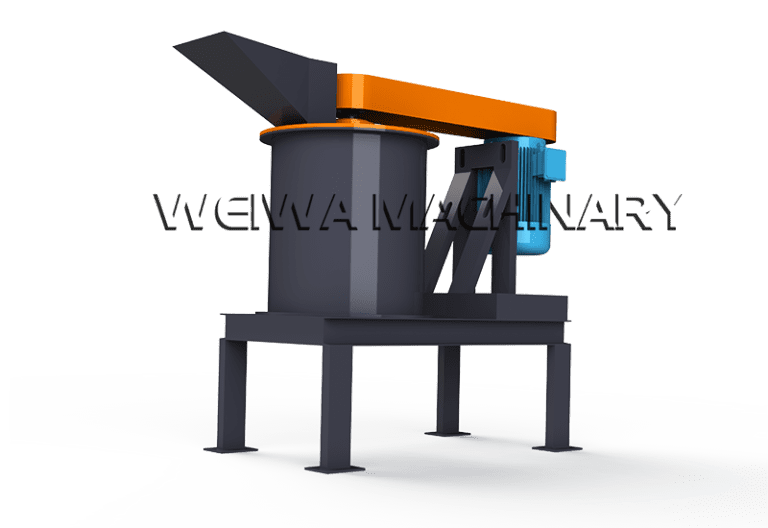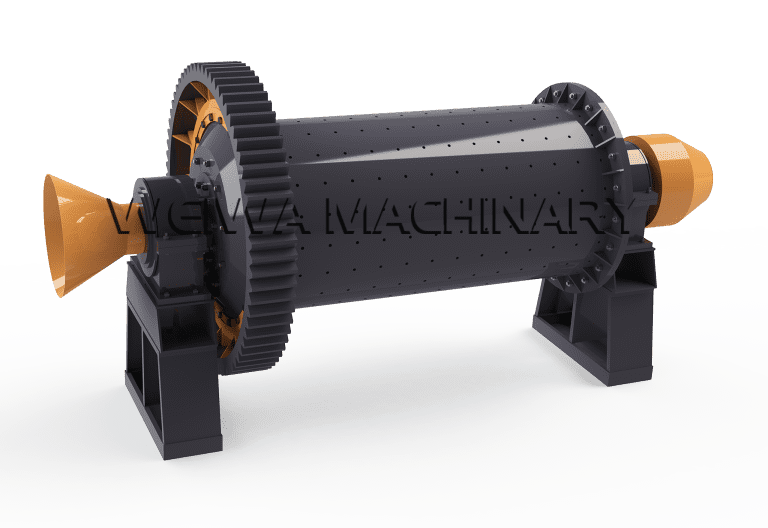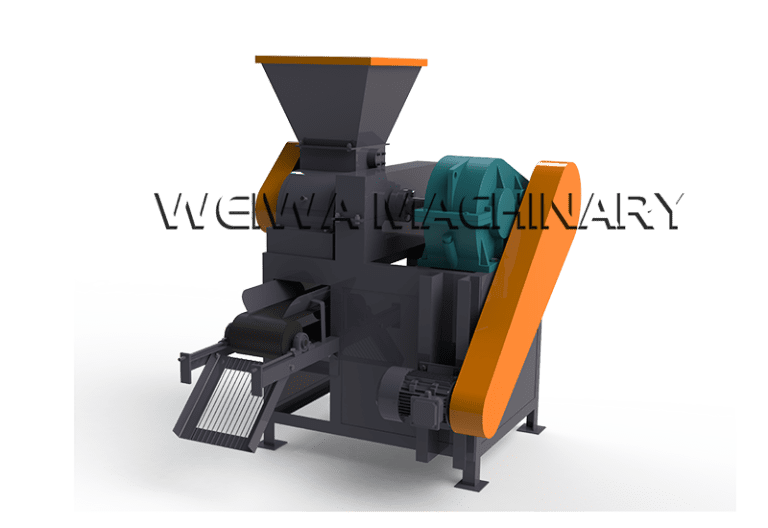
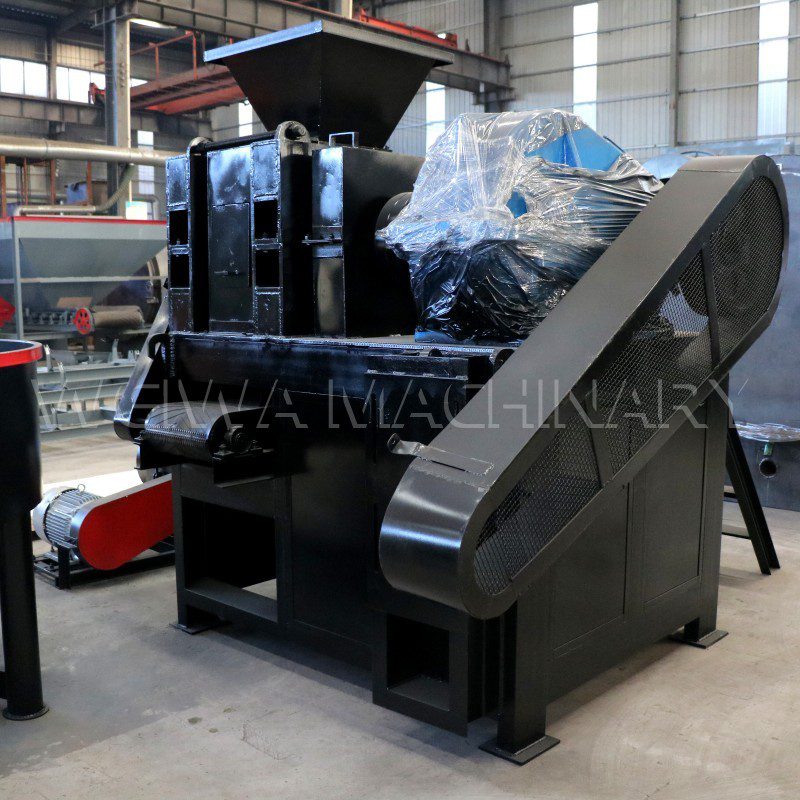
Last week, the loading yard of Weiwa Machinery looked busier than usual. A full container was being secured for ocean freight, and inside it sat a freshly painted charcoal ball press machine, a double-roller press unit, a crusher, a rotary dryer, a belt conveyor, and a semi-automatic bagging machine. This was not a random export order. It was a complete charcoal briquette machine production line built for a client in India who planned to start making charcoal balls from coconut shell powder and wood charcoal dust.
The order started with a simple inquiry about a ball charcoal briquettes machine, then moved into feedstock analysis, hourly capacity planning, voltage confirmation, and finally a custom factory layout. By the time the machine was bolted to the steel frame in our workshop, the India buyer already had the foundation drawing, the power requirement sheet, and the operator training schedule. That is how Weiwa Machinery handles export projects.
Shipment Scene at Weiwa Factory for the India Charcoal Ball Press Machine
The dispatch day began with a final inspection. Our quality engineer checked roller alignment, hydraulic pressure gauge, reducer oil level, and the gap between the two pressing rollers. The charcoal ball press machine was rotated manually to confirm the rollers did not scrape. Then the electric panel was powered on for a no-load test. The motor ran smoothly, the gearbox stayed quiet, and the discharge chute ejected test balls evenly.
After the running test, the machine was cleaned, wrapped with anti-rust film, and fixed on a steel skid. The crusher and dryer were placed first because they occupy more volume. The charcoal ball press machine was loaded second, standing upright with wooden blocks on both sides. Conveyor sections were folded and strapped. Spare rollers, bearing sets, and tools were packed in a separate plywood box marked with the client’s name and project number.
Photographs were taken from six angles. One showed the nameplate of the ball charcoal briquettes machine. Another showed the India destination label. A third captured our warehouse manager signing the packing list while the freight forwarder checked the seal number. None of this was for show. Making charcoal balls in India means the client expects the machine to arrive in working condition, not as a repair project.
Weiwa Machinery has shipped charcoal briquette machine lines to Maharashtra, Tamil Nadu, Gujarat, Uttar Pradesh, and Karnataka. Each shipment teaches us something new about local voltage, humidity, raw material moisture, and labor habits. The India market is not a copy of Africa or Southeast Asia. It has its own rhythm, and the charcoal ball press machine has to fit that rhythm.
Why Making Charcoal Balls in India Is Gaining Speed
India produces huge volumes of agricultural residue every year. Rice husk in the north, sugarcane bagasse in Maharashtra and Uttar Pradesh, coconut shells along the Kerala and Tamil Nadu coast, and sawdust from furniture clusters in Gujarat and Punjab. Much of this material is either burned in the open or sold at low price. A charcoal briquette machine turns that waste into a denser, cleaner, and more valuable fuel.
Making charcoal balls in India is attractive for three reasons. First, the raw material is local and often cheap. Second, charcoal balls burn longer than loose powder and create less dust during handling. Third, small factories can start with one charcoal ball press machine and later add a crusher, dryer, and conveyor when orders grow.
Urban demand also plays a role. Restaurants, tandoor shops, hotels, and resort kitchens want uniform BBQ charcoal that lights fast and does not break in the bag. Industrial users such as foundries, brick kilns, and steam boilers look at charcoal balls as a substitute for expensive imported coal. When the calorific value is stable and the ash content is low, the charcoal briquette machine becomes a profit center rather than a cost center.
Government programs on bioenergy, waste-to-wealth, and cleaner cooking also push the sector forward. While subsidies differ by state, the direction is clear. India wants less open burning and more formalized biomass fuel plants. A ball charcoal briquettes machine fits that policy direction without requiring complex chemistry or foreign binders.
Local Feedstock Changes the Machine Design
Coconut shell charcoal from Kerala is brittle and low in moisture. Sawdust charcoal from Punjab may carry higher volatile content. Bagasse-based powder behaves differently again. The charcoal ball press machine must handle these variations. Weiwa adjusts roller pocket depth, pressing pressure, feeder speed, and binder recommendation based on the sample the India client sends us. This is why we never ship a charcoal briquette machine without knowing the feedstock.
What a Charcoal Briquette Machine Actually Does?
A charcoal briquette machine is a densification device. It takes fine carbon powder, usually under 3 mm, mixes it with a small amount of binder and water, and squeezes it between two counter-rotating rollers. Each roller carries half-spherical or customized pockets. When the pockets meet, the powder is compressed into a solid ball.
The ball charcoal briquettes machine does not melt the material. It uses mechanical pressure to force particles closer until van der Waals forces, binder film, and surface friction hold the shape. After ejection, the balls are soft. They need drying. After drying, they become hard, water-resistant enough for normal storage, and easy to stack on pallets.
The charcoal ball press machine is different from a screw extruder. A screw machine pushes material forward and forms cylindrical sticks. A roller press forms discrete balls, pills, ovals, or pillows. For making charcoal balls in India, the roller press is more common because the shape is familiar to BBQ users and the output per hour is easier to scale.
Hydraulic Pressure Versus Mechanical Pressure
Some low-cost presses use spring-loaded mechanical pressure. They are simpler but less stable when the powder moisture changes. Weiwa uses a hydraulic assisted double roller system on most India-bound units. The hydraulic unit keeps constant pressure on the rollers even when a hard impurity passes through. The result is fewer misshapen balls and less roller wear. For a charcoal briquette machine running two shifts a day, that stability matters more than the initial price difference.
Inside a Complete Charcoal Ball Press Machine Production Line
A single charcoal ball press machine is not a factory. The factory is the line. Weiwa plans the line as one connected system.
The process starts with carbonization if the client receives raw biomass. If the client already buys charcoal powder, carbonization is skipped. The powder goes into a crusher to reach uniform size. Oversized lumps are reduced to below 80 mesh for smooth pressing.
Next is the mixer. Charcoal powder, binder, and water are blended until the mixture feels like damp coffee grounds. Too dry and the ball cracks. Too wet and it sticks to the roller. The mixer discharge drops onto a belt conveyor that feeds the buffer hopper above the charcoal ball press machine.
Inside the press, the material falls into the roller pocket, gets squeezed, and pops out as a green ball. The balls fall onto a discharge conveyor and move toward the drying zone. Weiwa often recommends a mesh belt dryer for India because it controls temperature and avoids direct sun dependency during monsoon.
After drying, the balls are cooled, weighed, and packed. A small plant may use manual bagging. A commercial plant making charcoal balls in India for multiple states may use a semi-automatic weighing and sewing machine. The whole line is wired to one control cabinet so the operator can start or stop the system in sequence.
Why Conveyor Height Matters in India Factories?
Many India buyers rent a shed with a 4 meter height limit. If the dryer is too tall, the line will not fit. Weiwa draws the layout before production. We adjust leg height, dryer length, and platform position so the charcoal briquette machine line fits the real building, not an ideal building. This is part of the customization service we offer with every charcoal ball press machine export.
Raw Materials Indian Buyers Use for Making Charcoal Balls
India is rich in diverse biomass. The most common inputs for a ball charcoal briquettes machine are coconut shell charcoal, hardwood charcoal dust, rice husk char, sugarcane bagasse char, sawdust char, and coal powder blends. Some clients mix 70 percent coconut shell charcoal with 30 percent sawdust charcoal to balance price and burning time.
The binder can be cassava starch, corn starch, guar gum, molasses, or a proprietary inorganic binder. For food-grade BBQ charcoal balls, starch binders are preferred. For industrial fuel balls, molasses or lignosulfonate works well and costs less. The charcoal briquette machine does not care about the binder brand. It cares about moisture, particle size, and feed consistency.
We always ask the India client to send a 5 kg sample. We run a bench press test in our workshop. Only after we see the ball hold shape and survive a drop test do we set the roller pressure for the full-size charcoal ball press machine.
How Weiwa Engineers the Charcoal Ball Press Machine for India?
India’s power supply can be 415V three phase 50Hz, but some rural sheds have unstable voltage. Weiwa installs a wider tolerance electrical cabinet and recommends a stabilizer for plants outside city limits. The motor rating is selected with a 15 percent buffer so the charcoal briquette machine does not trip during summer peak load.
Rollers are made from 65Mn or alloy steel depending on the abrasive level of the powder. For coconut shell charcoal, a medium hardness roller lasts long. For coal and charcoal mixed powder, we harden the roller surface to resist scoring. Pocket shape is CNC machined so every ball weighs the same within 2 grams.
The frame is heavy welded steel, not thin channel iron. A charcoal ball press machine vibrating on a weak frame will loosen bolts within a month. Weiwa uses box-type frames and adds vibration pads under the base. The India client may not see the pad, but they feel it in reduced noise and longer bearing life.
Custom Ball Shape and Size
Not every India buyer wants a perfect sphere. Some want 25 mm balls for hookah. Some want 40 mm balls for BBQ. Some want oval balls for traditional tandoor use. The ball charcoal briquettes machine can be rebuilt with new roller pairs in four hours. Weiwa keeps roller drawings for each client so reordering is fast.
After-Sales Support and Custom Layout Planning from Weiwa Machinery
Weiwa Machinery has more than thirty years of experience in briquette and compaction equipment. Our workshop in China has built lines for charcoal, coal, mineral powder, gypsum, and biomass. The India shipment was handled by the same team that serves Africa, Indonesia, Turkey, and Chile.
Every charcoal ball press machine order includes a dedicated after-sales engineer. After the container reaches the India port, the client receives the foundation drawing, the utility connection diagram, the installation video, and the spare parts list. If needed, our engineer joins a video call during installation. For larger lines, we can send a technician on site subject to visa and schedule.
Customization is not limited to the machine color. We redraw the production line to match the client’s land. Gate position, raw material inlet, finished product outlet, office room, and dust collection point are all marked. The charcoal briquette machine is placed where the maintenance worker can open the roller cover without moving the dryer. That kind of planning saves the India client two weeks of trial and error.
Spare parts such as rollers, bearings, scraper blades, and hydraulic seals are shipped with the line or sent by air later. We keep a record of each machine serial number, so when the client writes to [email protected], we already know which roller pocket they use.
Contact Weiwa Machinery for a Charcoal Briquette Machine Quote
If you are planning to start making charcoal balls in India, the right time to talk to a manufacturer is before you rent the shed, not after. Weiwa Machinery can help you choose the correct ball charcoal briquettes machine model, estimate hourly output, calculate dryer length based on local humidity, and send a factory layout drawing within a few working days.
We are not a trading company. We are the factory. The charcoal ball press machine you see in the container is the one we welded, assembled, and tested. Our sales team replies in English, Spanish, Russian, Arabic, and French. For the India market, we already have experience with 415V panels, coconut shell samples, and monsoon moisture control.
Reach us directly:
Email: [email protected]
Phone / WhatsApp: +86 18439853888
Phone: +86 18439853888
Tell us your raw material, target hourly capacity, available shed size, and local voltage. We will reply with a proposed charcoal briquette machine line, a price range, and a layout sketch. If you already have a crusher or dryer, we can integrate the new charcoal ball press machine into your existing setup.
Weiwa Machinery has over thirty years of work experience in the briquetting industry. We provide professional after-sales service, customized machine design, and CAD drawings for site planning. Whether you need one ball charcoal briquettes machine or a full making charcoal balls production line in India, our team is ready to support your project from the first email to the first commercial bag of charcoal balls.
The container leaving our yard this month is not just steel and motors. It is a working plan for an India entrepreneur who looked at coconut shell waste and saw fuel, jobs, and export potential. That is the kind of project Weiwa Machinery wants to be part of.