Earlier this quarter, Weiwa Machinery completed the shipment of a heavy-duty hammer crusher to a long-term partner in the Philippines. The order was not just another export document closed in Henan and forgotten overseas. The client requested a live pre-acceptance workflow: factory load test in China, container packing with humidity protection, arrival inspection in Manila, and a full on-site trial run with local limestone inside their own quarry yard. The hammer crusher for the Philippines program was designed around one question every Philippine buyer eventually asks. Will this machine survive tropical humidity, crush variable limestone feed, and still deliver uniform aggregate without constant hammer changes?
Why the Philippines Market Needs a Reliable Hammer Crusher?
The Philippines is not a single crushing environment. It is an archipelago where a cement plant in Cebu, a limestone quarry in Bulacan, a coal handling yard in Davao, and a construction-recycling yard in Metro Manila all face different feed size, moisture, and power conditions. Still, they share one pattern. Most of their primary soft-to-medium hard material is limestone, gypsum, shale, coal, and demolition concrete. That is exactly the zone where a hammer crusher outperforms a jaw or cone crusher on capital cost, footprint, and single-pass reduction ratio.
Limestone and Coal Crushing Demand in Philippine Quarries
Limestone is the backbone of Philippine cement and aggregate supply. Cement manufacturers need fine raw meal feed. Quarry operators need 5–20 mm road base and 0–5 mm filler. A hammer crusher converts 200 mm limestone lumps into 8–15 mm chips in one rotor pass, which removes the need for a separate secondary cone in many small plants. Coal traders in the Visayas region also use hammer mills to break imported steam coal from 80 mm to 20 mm before boiler feeding. In both cases, the machine pays back faster because the screen grate controls output size mechanically instead of relying on closed-circuit conveyors.
Tropical Climate Challenges for Crushers in the Philippines
Philippine sites punish imported equipment in three ways. First, ambient humidity stays above 70 percent for months, so unprotected rotors rust before commissioning. Second, typhoon-season rain raises feed moisture above 6 percent, which clogs screens on low-quality hammer mills. Third, coastal sites near Manila Bay or Cebu Port carry salt aerosol that eats bearing seals. Weiwa’s hammer crusher for the Philippines version answers these issues with a sealed rotor assembly, epoxy-coated frame welds, and a raised discharge chute that reduces slurry buildup when feed is wet.
Inside the Weiwa Hammer Crusher Shipment to the Philippines
The unit in this case was a PC-1000×1000 single-stage hammer crusher rated at 30–45 tph for limestone, equipped with 24 manganese hammers, a 90 kW slip-ring motor, and a 12 mm bottom screen. The Philippine client initially asked for a jaw plus cone combo, but our sales engineer ran a feed simulation using their supplied limestone samples and proved the hammer route would cut equipment cost by 31 percent and save 18 kW per ton.
Factory Inspection and Load Test Before Container Loading
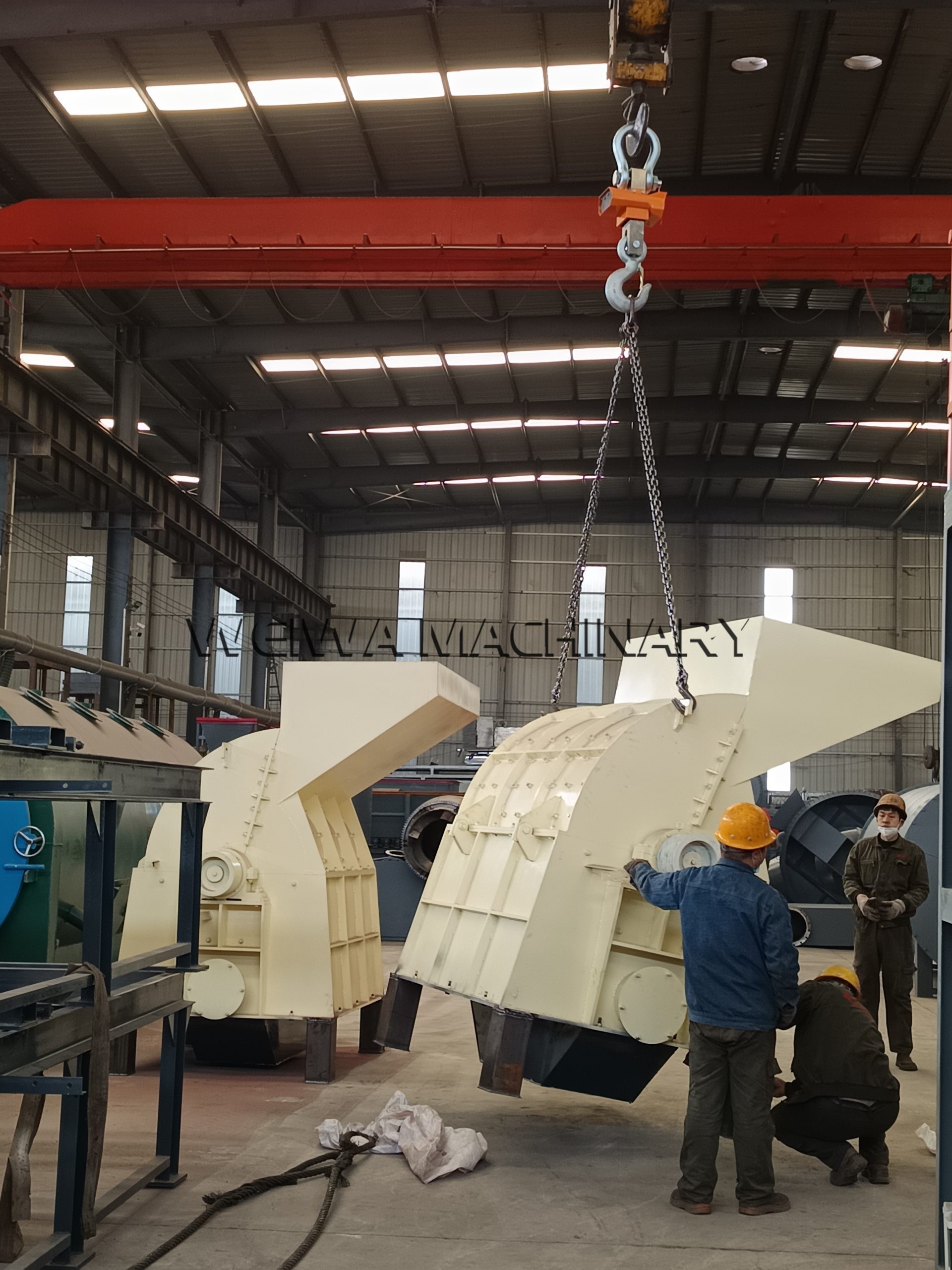
Every Weiwa hammer crusher passes a no-load run of 30 minutes and a load run of 60 minutes with 5-ton limestone bags before export. For this Philippine unit, we added a video call with the client’s maintenance head. They watched the rotor balance test, hammer clearance check, and screen gap calibration at 10 mm, 12 mm, and 15 mm. Vibration was recorded at 2.1 mm/s, well under the 4.5 mm/s limit in ISO 10816. Bearing temperature stabilized at 58 °C after 45 minutes. Those numbers matter for the Philippines because sea freight adds three weeks of inactivity; the client wanted proof the machine would not arrive with hidden misalignment.
Packaging and Freight Preparation for Manila Port
The crusher main frame was naked wrapped with anti-rust paper and steel bands. Rotors, hammers, screens, and electrical panels were crated in plywood with silica gel bags inside because the container would cross the South China Sea during monsoon transition. We printed the destination label as “Hammer Crusher for the Philippines – Quarry Site Bulacan” instead of a generic model code. That small step prevented one common delay: Philippine customs often holds machinery if the commercial invoice and bill of lading describe the goods differently from the crate stencil. The container left Qingdao, transshipped at Shanghai, and cleared Manila in six days.
On-Site Commissioning and Trial Run Results
Our remote commissioning package included foundation drawings, anchor bolt torque table, VFD parameter sheet, and a 40-minute operator training video dubbed in English with Filipino subtitles. The client chose self-installation with video support. After foundation curing, the hammer crusher was lifted, aligned, and coupled to a 75 kW actual motor because their site transformer allowed only 110 kW total load. Weiwa had already confirmed the machine would reach 38 tph at 75 kW with 12 mm screen, so the downsized motor was not a compromise.
Trial Crushing with Philippine Limestone Feed
The first trial used blasted limestone from their own quarry, bulk density 1.45 t/m³, compressive strength 85 MPa, feed size 40–180 mm, moisture 3.8 percent. The hammer crusher ran for two hours continuously. Output was collected in 20-minute batches.
Average throughput was 36.4 tph. Particle size distribution showed 41 percent in 5–10 mm, 37 percent in 10–15 mm, 18 percent in 0–5 mm, and only 4 percent above 15 mm. The oversize was returned to the hopper and disappeared in the second pass. Rotor speed was fixed at 980 rpm. Amperage fluctuated between 118 A and 134 A, confirming stable load without stall. The client’s old jaw crusher plus manual griddle sieving previously gave them 22 tph and 11 percent oversize.
Throughput Particle Size and Rotor Speed Observations
We ran a second shift at 1,100 rpm with the same 12 mm screen. Throughput climbed to 41 tph, but 0–5 mm fines rose to 27 percent, which their cement client did not want for road base. We then dropped to 10 mm screen at 980 rpm. Fines dropped to 14 percent, oversize to 2 percent, throughput to 32 tph. The client selected the 12 mm at 980 rpm setting as the daily profile. That is the kind of trade-off a crusher for the Philippines must expose early. Philippine aggregate buyers argue over every 5 percent of fines because it changes cement dosage and compaction behavior.
After eight hours, hammer tip wear measured 0.8 mm average. At that rate, the client can expect 900–1,100 working hours per hammer set on limestone, longer if they reverse hammers at 500 hours. Bearing temperature peaked at 61 °C. No abnormal noise above 85 dB was recorded at 1 meter.
How a Hammer Crusher Compares with Other Crushers for the Philippines?
A jaw crusher is better when feed exceeds 250 mm and includes hard volcanic rock. A cone crusher wins for basalt and andesite in CARAGA mining sites. But for the majority of Philippine limestone, gypsum, coal, and concrete recycling, the hammer crusher remains the lowest-cost entry point. It replaces two crushing stages with one machine. It occupies 40 percent less concrete foundation than a jaw-plus-impact train. It lets a small quarry in Pampanga or Iloilo start with one operator instead of three.
The downside is real. Feed must stay under 200 mm and moisture under 10 percent. Abrasive quartz-rich ore will chew hammers fast. That is why Weiwa never sells a hammer crusher for the Philippines without a feed analysis form. We ask for three buckets of representative material before quoting. The trial above worked because the client accepted that discipline.
Selecting the Right Hammer Crusher for Philippine Buyers
Philippine buyers usually start with price, then regret it when spare parts vanish. The correct sequence is feed size, target output size, hourly demand, power ceiling, and only then budget. A 30 tph quarry in Batangas does not need a 90 kW PC-1200. A 60 tph cement pre-crusher in Cebu cannot survive on a 55 kW PC-800. Weiwa maps each hammer crusher model to a Philippine use case: PC-600 for 8–15 tph farm lime, PC-800 for 15–25 tph coal, PC-1000 for 30–45 tph limestone, PC-1250 for 60–80 tph cement raw meal.
Screen gap is the hidden lever. Most buyers leave it at the factory default. Our Philippine client changed it twice in week one and locked the 12 mm setting by week two. Motor starting mode matters too. For rural Philippine sites with unstable voltage, we recommend soft starters, not direct-on-line, because hammer rotor inertia spikes current 6x on cold start.
Weiwa Machinery After-Sales Support for the Philippines
Weiwa Machinery keeps hammer sets, rotors, screens, and bearing kits in stock for the Southeast Asia route. For this Philippine shipment, we sent one extra rotor and 24 hammers inside the same container so the client never waits for ocean freight during a breakdown. Our technical team connects over WhatsApp video within four hours of a fault call. Major repairs can be supported by a Chinese engineer flight to Manila, then land transfer, within 72 hours.
Spare parts pricing is published per kilogram of wear steel, not hidden behind a quote wall. Philippine clients tell us that transparency is the reason they reordered. A hammer crusher is only as good as the day its first hammer cracks. If the replacement takes six weeks, the machine becomes a statue.
About Weiwa Machinery
Weiwa Machinery is a Henan-based industrial equipment manufacturer with more than 30 years of experience in crushing, grinding, and material-processing systems. Our products have been exported to over 120 countries and regions, including repeated shipments of hammer crusher, jaw crusher, ball mill, and briquetting lines to the Philippines, Indonesia, India, and Chile. We do not only sell machines. We run feed tests, simulate site power, pack for tropical transit, and stay on call after commissioning.
For this Philippine hammer crusher project, the client’s words after the trial mattered more than any brochure: “The machine ate our limestone and gave us the size our buyer wanted without us touching the screen for eight hours.” That is the standard we design for.
If you are evaluating a crusher for the Philippines, send us your material photos, feed size, and target tph. We will return a model sheet, a load-test video, and a container packing plan. We answer as engineers, not as a call center.
Contact Weiwa Machinery
Email: [email protected]
Phone: +86 18439853888
Website: https://crushmixplant.com/crusher-machine/hammer-crusher.html