The container yard at Jeddah Islamic Port was already 38°C at 9 a.m. when the Weiwa logistics crew finished lashing the final cradle. Inside that 40-foot high-cube container was a WCC1380 hydraulic cone crusher, painted in Weiwa desert-finish orange, bound for a limestone and basalt aggregate line outside Riyadh. This was not a standard export. The Saudi buyer requested a witnessed factory acceptance test, a simulated 45°C run, and a 72-hour on-site trial before final payment. This blog documents that shipment, the engineering behind the machine, and the trial numbers measured on Saudi ground.
For Weiwa Machinery, a cone crusher is never just a piece of steel. It is a compression-class machine that must hold chamber geometry under variable feed, keep lubricant stable under heat, and produce a repeatable gradation curve that meets Saudi Standards Organization expectations for road base and ready-mix concrete. When the destination is Saudi Arabia, those expectations collide with silica dust, grid fluctuation, and gigaproject-scale volume requirements.
Why the Saudi Arabia Market Needs a Reliable Cone Crusher?
Saudi Arabia is the largest cone crusher market in the GCC block, accounting for roughly 32% of regional demand in 2025, driven by Vision 2030 infrastructure programs, NEOM, the Red Sea Project, Qiddiya, and accelerated mining licenses for limestone, granite, copper and gold. The Kingdom’s aggregate producers are moving away from single-stage jaw-plus-impact setups toward cone crusher in Saudi Arabia secondary and tertiary circuits because consultants now specify tighter 0–5 mm, 5–10 mm, 10–20 mm and 20–31.5 mm bands for expressway and precast work.
Vision 2030 and Aggregate Demand
Every kilometer of new highway, every cubic meter of tunnel shotcrete, and every precast pillar for logistic hubs consumes crushed stone. Industry estimates put GCC cone crusher market value at USD 40.7 million in 2025, growing at 5.76% CAGR to 2034. Saudi Arabia alone absorbs the single largest share because its giga-projects are not cyclical real-estate plays; they are state-backed, multi-decade build-outs. A crusher in Saudi Arabia must therefore be specified for 6,000+ operating hours per year, not seasonal use.
Climate and Material Challenges in the Kingdom
Western province basalt is high in silica and abrasive. Central province limestone carries clay seams and intermittent moisture from site sprinkler systems. Summer ambient hits 46–50°C in Riyadh, Yanbu and Tabuk. Fine dust penetrates standard IP54 cabinets within months. Grid voltage in remote quarries swings ±8%. These are the reasons a generic cone crusher for Saudi Arabia cannot be a warehouse stock unit with a new coat of paint. It needs oversized oil coolers, positive-pressure electrical enclosures, silica-resistant manganese, and a hydraulic clamping system that survives thermal cycling.
Inside the Weiwa Cone Crusher Prepared for Saudi Arabia
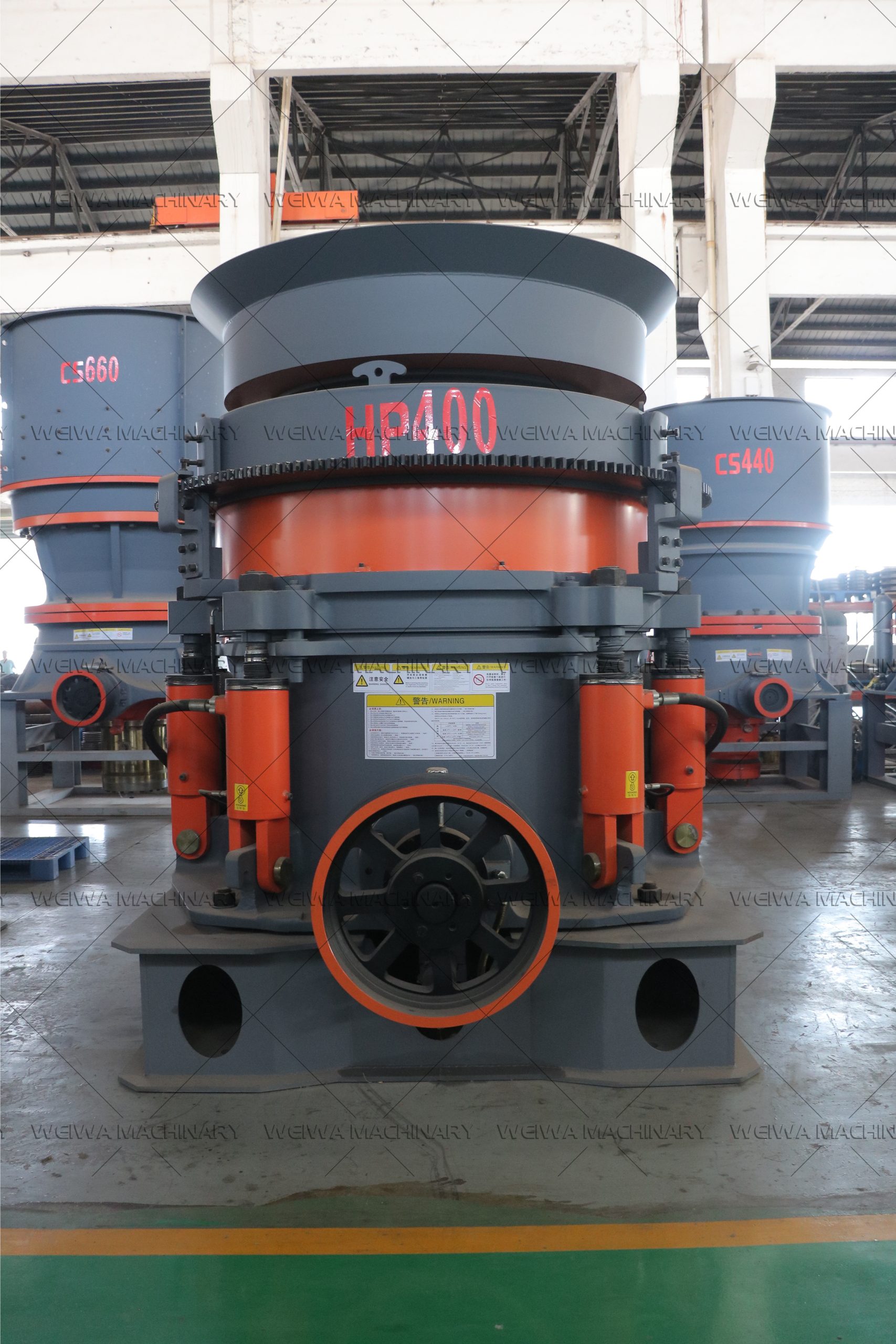
The unit we shipped was a WCC1380 single-cylinder hydraulic cone crusher, paired mechanically with a Weiwa CJW1060 jaw as primary and a 2YK2460 screen for closed circuit. The cone itself was configured with a medium-fine chamber, 225 mm max feed, 13–38 mm CSS range, 132 kW main motor rated for 60 Hz Saudi grid, and a bush-type eccentric assembly instead of a spider bearing to tolerate off-axis load from slabby basalt.
Key modifications for the Saudi order included a 40% enlarged radiator with dual thermostatic fans, a Labyrinth + lip-seal combo on the main shaft, a 60°C synthetic hydraulic fluid fill, an Arabic/English HMI with real-time amp, lube temperature and CSS readout, and a spring-hydraulic overload release tuned for 250 bar trip. The mantle and bowl liner were Weiwa W-Mn18Cr2 with ceramic insert option offered but declined by the client due to cost target.
From a crushing-theory standpoint, a cone crusher reduces material by compressive engagement between rotating mantle and stationary bowl. The Saudi client’s target was not maximum tonnage but maximum tons within the 10–20 mm band, because that fraction carries the highest margin in Riyadh ready-mix market. We therefore set the trial CSS at 19 mm, pump speed 980 rpm, and choke-fed the chamber to keep the crushing zone full, which is the single biggest lever for cubical shape and liner life.
From Gongyi Factory to Jeddah Port Loading Site
Weiwa’s main fabrication base in Dahuangye Industrial Zone, Gongyi, Henan, completed shop assembly in week 6 after deposit. Week 7 was factory acceptance: 8-hour no-load run, 4-hour load run on local Henan basalt simulant, laser check of mantle run-out, and hydraulic pressure hold test. The Saudi consultant joined via live video with a third-party inspector physically present.
Export packing followed Weiwa’s heavy-machinery protocol: anti-rust VCI film on machined faces, 100 mm plywood crate for the control cabinet, custom welded cradle for the mainframe to stop torsional movement, desiccant bags inside motor terminal boxes, and shock labels on the feeder and lubrication tank. The bill of lading listed Jeddah as discharge port, then inland haulage to Riyadh by the client’s transporter.
One detail matters for SEO and procurement teams alike: we stamped the nameplate as Cone Crusher for Saudi Arabia – WCC1380 – WEIWA and mirrored that string in the packing list, COC, and SASO draft certificate. Buyers in the Kingdom search exactly that phrase when comparing offers, and customs clerks match it faster.
On-Site Trial Results of the Cone Crusher in Saudi Arabia
Installation took 58 hours from container open to first rock. Weiwa sent one senior field engineer; the client supplied a 250 kVA generator backup and a 988-size loader. Feed material was a blend of 60% quarry basalt and 40% site limestone reject, sized 0–180 mm after jaw. The cone ran in closed circuit with the screen return.
Throughput and Particle Size Distribution
Over a 72-hour witnessed trial, average hourly throughput was 268 t/h at 19 mm CSS, peaking at 304 t/h in hour 61 when feed was dry and well-sized. Power draw averaged 118 kWh per 100 tons, about 6% lower than the client’s existing symons-style 4.25 ft unit on the adjacent line. Product sampling every 8 hours showed 10–20 mm fraction holding 41–44% of total output, 5–10 mm at 23%, 0–5 mm at 19%, and oversize above 20 mm below 4%. Flakiness index measured 11%, under the 15% SASO road-base limit.
Liner wear after 4,200 t processed was 1.8 mm on the mantle and 2.1 mm on the bowl, projecting a 90,000–100,000 ton liner life on basalt-dominant feed. The client’s previous vendor quoted 60,000 tons. That difference alone justified the hydraulic upgrade cost.
Heat, Dust and Voltage Stability Observations
Ambient during the trial swung 39–47°C. Lube oil inlet to the eccentric stayed at 51–54°C thanks to the enlarged cooler; motor winding temperature never exceeded class F limit. We logged three grid dips to 342 V and one surge to 418 V; the VFD-controlled auxiliary pump rode through without trip, and the main contactor held because we specified 60 Hz coil with 380–440 V tolerance.
Dust was the real test. After 72 hours, we pulled the electrical cabinet filter: positive-pressure fan kept internal delta P at 12 Pa, and the PLC board had no visible silica layer. The client’s maintenance supervisor noted that their Chinese competitor unit needed cabinet blow-out every 10 days; the Weiwa cone crusher for Saudi Arabia design target is 45 days between cabinet inspections.
How to Select a Crusher for Saudi Arabia Quarry Operations?
Choosing a crusher in Saudi Arabia is not about catalog tonnage. It is about five field variables. First, match motor frequency to the site: most industrial zones are 60 Hz, but older plants and generators drift. Second, size the cone 25–30% above limestone nameplate when feed is granite or basalt, because abrasive rock lowers real capacity. Third, demand CSS lock hydraulic clamping rather than manual shim, because thermal expansion in summer changes gap by 0.5–1.2 mm. Fourth, specify oil cooler capacity at 55°C ambient, not 40°C. Fifth, verify spare-part lead time to Dammam or Jeddah; a liner from Europe in 9 weeks kills a quarry, whereas Weiwa holds WCC-series bowls in stock for Middle East clients.
Buyers comparing a cone crusher in Saudi Arabia tender should ask vendors for a witnessed trial on local rock, not factory basalt from Zhengzhou. Weiwa now offers that as standard for GCC orders above 100 t/h.
Weiwa Machinery After-Sales Support in the Middle East
Weiwa Machinery is not a trader reselling third-party frames. We are a Henan-based manufacturer with 30+ years in crushing, exporting to 120+ countries, and we treat Saudi Arabia as a strategic corridor. For this client we supplied Arabic/English manuals, a 12-month wear-part kit shipped with the machine, remote HMI diagnostics via VPN, and a 48-hour response clause for major-component failure. Our Middle East communication line is answered in working hours Riyadh time.
Operators received two days of on-site training: choke-feeding discipline, CSS calibration with lead weight, lube sampling cadence, and hydraulic pre-charge check. The client’s plant manager later emailed that liner change time dropped from 9 hours on their old symons to 3.5 hours on the WCC1380 because the single-cylinder lift exposes the mantle in one stroke.
About Weiwa Machinery
Weiwa Mining Machinery, headquartered in Gongyi, Henan, China, manufactures jaw crushers, impact crushers, cone crushers, vibrating screens, ball mills and complete aggregate and mineral plants. With over three decades of engineering history, CE and ISO 9001 aligned production, and more than 2,000,000 equipment users served globally, Weiwa focuses on rugged, climate-adapted machines for mining, construction, recycling and cement clients. We offer customized chambers, 60 Hz conversions, desert cooling kits, and turnkey commissioning. For Saudi Arabia and GCC inquiries, our team provides technical selection, trial-run data, and spare-part stock planning.
Contact Weiwa Machinery:
Email: [email protected]
WhatsApp / Phone: +86 18439853888
Address: Dahuangye Industrial Zone, Gongyi City, Henan Province, China
If you are specifying a cone crusher for Saudi Arabia or benchmarking a crusher in Saudi Arabia tender, request the WCC-series trial sheet from our team. The Riyadh basalt data in this blog is available as a PDF with sieve curves, power charts and liner-wear photos.