Brazil is one of the world’s most resource-rich countries, with vast reserves of iron ore, bauxite, granite, river sand, and fertile agricultural land. Across the Minas Gerais iron belt, the Amazonian alluvial gold regions, and the São Paulo–Paraná aggregate corridors, material classification is a daily operational challenge. High moisture content, clay-bound aggregates, and variable feed size make traditional vibrating screens prone to blinding. That is why demand for the rotary screen—also known as a trommel screen or drum screen—is growing rapidly among Brazilian processors.
What Is a Rotary Screen and Why It Matters in the Brazilian Market?
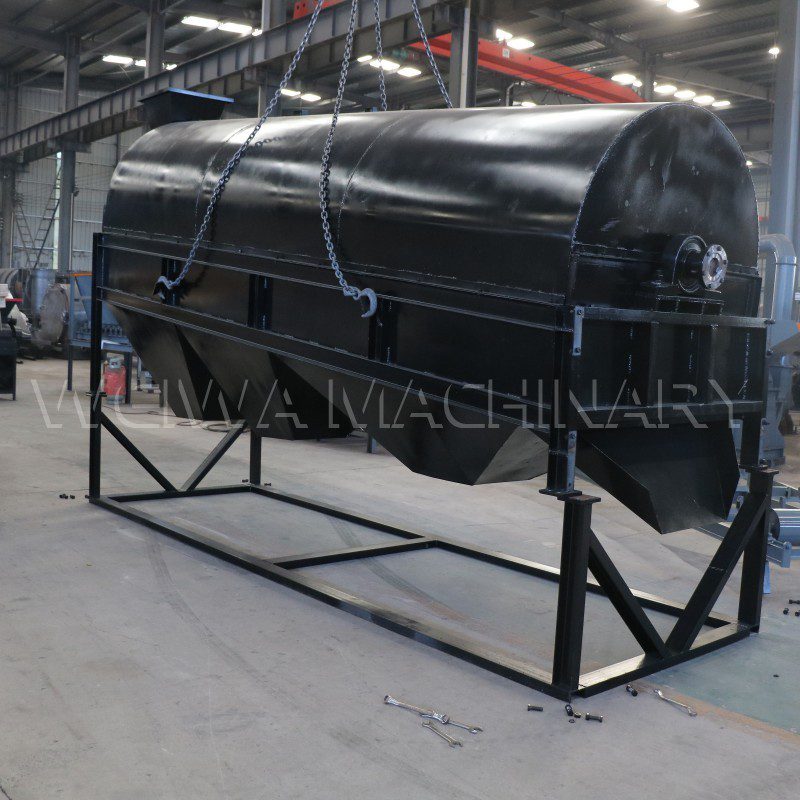
A rotary screen (trommel / drum screen / roller screen) is a mechanical sizing device consisting of an inclined rotating cylindrical drum fitted with perforated plates or woven mesh. Bulk material is fed into the elevated end; as the drum rotates, the tumbling action moves material toward the lower discharge while undersized particles pass through the screen apertures. Unlike high-frequency vibrating screens that rely on aggressive vibration, the rotary screen uses gentle rolling motion, which greatly reduces mesh blinding—especially important when screening the wet, sticky clay-laden aggregates commonly found in Brazilian quarries and placer gold sites. Learn more about our rotary / roller screen specifications here.
The term rotary screen in Brazil is increasingly searched by local quarry owners and mining EPCs because Brazilian climate conditions—seasonal rains in the southeast and tropical humidity in the north—regularly cause conventional screens to clog. A well-designed drum screen with internal lifters and optional brush-cleaning solves this pain point, making it a strategic investment for Brazilian operations targeting uninterrupted throughput.
Working Principle of Weiwa Machinery Rotary Drum Screen
Drum Structure and Inclination
Weiwa Machinery rotary screens are fabricated with heavy-duty rolled steel rings and support rollers mounted on a rigid chassis. The drum is inclined between 3° and 7°, a range proven to balance retention time (for accurate sizing) with material advance speed (for high capacity). Inside the drum, staggered lifting plates tumble the feed, ensuring every particle contacts the screen surface multiple times during a single pass.
Drive System and Speed Control
Power is transmitted from an IE3 electric motor through a geared reducer to the drive wheels. Rotation speed is deliberately kept low—typically 12 to 18 rpm—to generate a controlled cascading fall rather than centrifugal throwing. This low-speed design extends bearing life and minimizes noise, an advantage noted by Brazilian site managers who must comply with local occupational safety norms.
Screening and Discharge
Fine fractions smaller than the aperture drop through the drum into a collection hopper beneath; oversize material exits the drum tail into a separate chute. For multi-deck requirements, nested drums or sectional mesh changes allow two or three cut-points in one machine. During our pre-shipment rotary screen for Brazil test runs, we simulated feeds with 8–12% surface moisture and confirmed zero significant blinding on 5 mm, 10 mm, and 20 mm punched plates.
Why Brazilian Industries Choose Rotary Screens Over Vibrating Screens?
Iron Ore Pre-Screening in Minas Gerais
In the iron quadrangle, run-of-mine ore often carries fine clay from overburden mixing. Vibrating screens blind quickly under such conditions, forcing shutdowns for manual cleaning. A rotary screen placed ahead of the primary crusher or jig removes the −10 mm fraction—clay, fines, and lightweight waste—before they enter downstream equipment. Brazilian engineers we consulted reported up to 30% reduction in secondary crusher wear after adding a trommel scalping stage.
River Sand & Alluvial Gold in Northern Brazil
Alluvial deposits in Pará and Roraima contain gold-bearing sands mixed with organic matter and sticky lateritic clay. Rotary screens with integrated high-pressure water spray bars wash and size simultaneously. Our trial unit, configured as a rotary screen in Brazil alluvial application, achieved 92% liberation of +2 mm gold-host particles while rejecting >70% of the −2 mm slimes in a single pass.
Construction Aggregate & Recycled Concrete in Southeast Brazil
São Paulo and Rio de Janeiro metropolitan areas generate large volumes of construction and demolition waste. After primary crushing, C&D material must be separated into reusable 0–5 mm, 5–20 mm, and +20 mm fractions. The drum screen’s continuous tumbling action handles broken concrete with rebar remnants better than linear vibrating decks, which can snag on deformed metal pieces. Brazilian recyclers appreciate the enclosed drum option that suppresses dust—a requirement under current state environmental licenses.
Agricultural & Fertilizer Grading in the Cerrado
The Brazilian Cerrado produces massive quantities of soybeans, corn, and compound fertilizers. Granular fertilizers must be uniform to ensure even spreading. Rotary screens provide gentle handling that avoids pellet breakage—a common issue with aggressive shaker screens—while delivering precise cut-points (e.g., 2–4 mm for NPK blends).
Weiwa Machinery Rotary Screen Trial Run Results Shared by Brazilian Prospects
Before placing volume orders, several Brazilian trading partners requested a factory acceptance test simulating local feed characteristics. We replicated a typical Brazilian granite quarry feed—0–80 mm with 9% moisture and 15% passing 5 mm—and ran our GTS-series rotary screen at 60 t/h nominal capacity.
Screening Efficiency
The undersize recovery rate for the −5 mm fraction reached 94.6%, with only 3.2% of oversize misplaced into the fine stream. These numbers exceed the typical 88–90% benchmark quoted for vibrating scalpers on similar feeds, confirming the advantage of tumble-and-fall kinematics in wet conditions.
Anti-Blinding Performance
After four hours of continuous operation without brush activation, visual inspection showed less than 5% partial aperture obstruction. Engaging the optional spring-mounted cleaning brushes reduced visible blockage to near zero. Brazilian visitors noted this would eliminate the mid-shift manual hammer-cleaning routine familiar at their sites.
Noise and Vibration Levels
Sound pressure measured at 1 m distance was 68 dB(A)—well below the 85 dB(A) threshold referenced in NR-15 (Brazilian workplace safety regulation). Foundation vibration amplitude was under 0.3 mm, allowing installation on simple concrete pads without special isolation mounts, reducing civil works cost for Brazilian buyers.
Power Consumption
The 60 t/h unit consumed 5.5 kW during stable running, equating to approximately 0.092 kWh per ton screened. Compared with a comparable double-deck vibrating screen drawing 11–15 kW for equivalent duty, the rotary screen demonstrated clear energy savings—an increasingly important consideration given industrial power tariffs in parts of Brazil.
Key Technical Features of Weiwa Rotary Screens for the Brazil Market
Customizable Aperture & Drum Sections
We offer punched plate (round or slotted), woven wire cloth, or wedge wire inserts in apertures from 2 mm to 100 mm. Drums can be sectioned so that different mesh sizes are bolted in modular panels—ideal when a Brazilian client needs to switch between 5 mm sand classification and 20 mm coarse aggregate scalping without replacing the entire drum.
Heavy-Duty Support Rollers & Sealed Bearings
Tropical environments with high dust load demand robust lubrication. Weiwa screens use double-sealed spherical roller bearings in dust-proof housings, greased for extended intervals. Support tires are flame-hardened to resist wear from continuous drum rotation under full load.
Optional Enclosure & Spray Wash System
For Brazilian aggregate plants operating under strict emission controls, we supply fully enclosed drums with top-mounted inspection doors and a manifold of spray nozzles fed from plant process water. The washing action further improves separation of cohesive fines—critical in clay-bearing granite or basalt deposits.
Mobile & Skid-Mounted Configurations
Some Brazilian gold and sand operators work across multiple remote sites. We fabricate skid-mounted or wheel-mounted rotary screens complete with integrated feed hopper, discharge conveyors, and diesel-electric generator set, allowing rapid relocation without foundation work.
How to Select the Right Rotary Screen for Your Brazilian Operation?
Correct model selection begins with a detailed feed analysis: top size, percentage of fines, moisture, and material abrasiveness. Throughput target and desired cut-point(s) then determine drum diameter (typically 1000–2000 mm) and length (1500–6000 mm). In our experience supporting rotary screen in Brazil inquiries, most aggregate quarries choose a 1200 mm × 3000 mm drum for 40–80 t/h duties, whereas alluvial gold plants prefer 1500 mm × 4500 mm drums with integrated scrubber bars for 80–150 t/h washed throughput.
Weiwa engineers review your flow sheet free of charge and propose drum inclination, mesh specification, drive power, and optional features such as variable frequency drive for speed tuning—ensuring the supplied rotary screen matches actual Brazilian site conditions rather than generic catalog ratings.
Frequently Asked Questions about Rotary Screens for Brazil
Is a rotary screen suitable for very dry, dusty sand?
Yes. Although the rotary screen excels with wet/sticky feeds, it also performs well on dry sand if an open drum and dust-collection hood are used. For extremely fine dry powders (<1 mm), we may recommend a closed drum with aspiration connection.
Can Weiwa rotary screens be integrated into an existing crushing plant?
Absolutely. We design infeed chutes compatible with belt conveyor discharge heights common in Brazilian installations and provide CAD drawings for interface verification before fabrication.
What after-sales support does Weiwa provide to Brazilian clients?
We supply English & Spanish/Portuguese operation manuals, spare parts kits (screen panels, bearings, drive belts), and remote video commissioning. For container shipments to Santos or Rio de Janeiro ports, we assist with documentation and can recommend local agents for urgent wear-part replenishment.
Partner with Weiwa Machinery for Your Rotary Screen in Brazil
The Brazilian minerals, aggregates, and agriculture sectors demand screening equipment that resists clogging, delivers consistent cut accuracy, and keeps operating costs low. Weiwa Machinery’s rotary screens—engineered with heavy-duty drums, anti-blinding options, and proven trial-run performance—meet exactly those requirements. Whether you need a primary scalping trommel for an iron ore circuit in Minas Gerais, a washing drum for alluvial gold in the North, or a fertilizer grader for the Cerrado, our team is ready to customize a solution for you.
Contact Weiwa Machinery today to request a rotary screen quotation tailored for your Brazilian application, or ask for factory test videos matching your feed condition.
About Weiwa Machinery
Weiwa Machinery (Weiwa Mining Machinery) is a professional manufacturer of crushing, screening, and material handling equipment with over 30 years of engineering experience. Our product range includes rotary screens / roller screens, jaw crushers, hammer crushers, impact crushers, vibrating feeders, and complete stationary or mobile crushing & screening plants. Exported to more than 120 countries and regions—including Brazil, Peru, Indonesia, Russia, and across Africa—Weiwa serves mining, quarrying, construction, recycling, cement, and agriculture sectors worldwide.
- Email: [email protected]
- WhatsApp / Tel: +86 18439853888
- Address: Dahuangye Industrial Zone, Gongyi City, Henan Province, China
Our commitment: custom-engineered solutions, competitive factory pricing, 24/7 pre-sale & after-sales support, and spare parts service to keep your production line running.