In the past quarter, Weiwa Machinery completed the successful shipment of a High Strength Roll Crusher to a long-established aggregates and limestone processing client in northern Italy. This delivery marks another milestone in our growing presence across the European crushing equipment market. More than a simple export transaction, this project included pre-shipment factory acceptance testing, customized gap-adjustment configuration for Italian raw material characteristics, and remote commissioning support during the on-site trial run. The purpose of this article is to share with our readers—especially those evaluating a Roll Crusher for Italy or comparing Crusher in Italy options—how the High Strength Roll Crusher in Italy performed under real operating conditions, why the Italian market increasingly favors compression-type crushers for certain applications, and what technical considerations should guide your purchase decision.
Italy is home to a mature and sophisticated stone processing and cement raw-material industry. From the marble and limestone quarries of Carrara to the active cement plants in central Italy and the clay-rich deposits in the north, the demand for energy-efficient, low-fines-generation crushing equipment continues to grow. Many Italian operators find that traditional impact crushers produce excessive fines when processing medium-hard limestone or clay-bearing material, increasing dust-suppression costs and reducing saleable fractions. The High Strength Roll Crusher, with its compression-based crushing mechanism and adjustable roller gap, offers a compelling alternative.
Industrial Crushing Landscape and Demand for Roll Crusher in Italy
The Italian aggregates and mineral processing sector spans hundreds of active quarries, cement production facilities, and recycled-construction-materials plants. Northern Italy in particular sees significant activity in limestone, dolomite, clay, and recycled concrete processing. Environmental regulations under EU directives place emphasis on reduced dust emission, lower energy consumption per ton, and minimized over-crushing. These regulatory and economic pressures align closely with the strengths of a well-engineered Roll Crusher for Italy. Unlike primary jaw crushers or high-speed impact crushers, a double Roll Crusher operates at low rotational speed, generates comparatively little dust, and produces a more uniform particle-size distribution with fewer fines.
In the cement sector, Italian plants often require controlled-size reduction of raw mix materials—limestone blended with sticky clay or marl—before the raw mill. Clogging is a common issue in impact or hammer-type crushers when moisture exceeds five to eight percent. The High Strength Roll Crusher in Italy, especially when fitted with properly profiled rolls and a spring or hydraulic relief system, handles such moist or slightly sticky feeds without blockage. For secondary or tertiary crushing of limestone with compressive strength in the 80–150 MPa range, the double roll configuration delivers reliable throughput and consistent product grading, which in turn stabilizes downstream grinding circuits and reduces specific power consumption per ton of clinker produced.
Recycling operations in urban centers such as Milan, Turin, and Bologna also benefit from robust crushing equipment capable of processing demolition concrete and asphalt millings. Although impact crushers dominate this segment, there is a niche but growing interest in low-speed Crusher types that create less micro-fines, preserve reinforcing steel integrity, and require simpler wear-part management. The high-strength design we shipped to Italy was specified partly with future recycling-line integration in mind, illustrating the versatility expected from modern High Strength Roll Crusher equipment.
Italian Quarry Material Characteristics Favoring Compression Crushing
Limestone across central and northern Italy varies from soft, earthy varieties to dense, bedded deposits with localized silicified bands. Clay content—often present as thin partings or disseminated seams—can cause adhesion inside crusher housings if high-velocity impact is used. The counter-rotating rolls of a High Strength Roll Crusher nip the feed material between two hardened surfaces and fracture it along natural cleavage planes. This compressive action, combined with a modest shear component when corrugated or toothed roll surfaces are selected, reduces the tendency for plastic smearing of clay and yields a cleaner liberated product. For the customer in Italy, feed size varied between 0–150 mm after primary jaw crushing, with target discharge set at 0–25 mm for raw mill feed preparation. The ability to lock the roller gap hydraulically and fine-tune it without stopping the machine was a decisive factor in choosing Weiwa’s Roll Crusher over locally available alternatives.
Working Principle and Design Features of Weiwa High Strength Roll Crusher
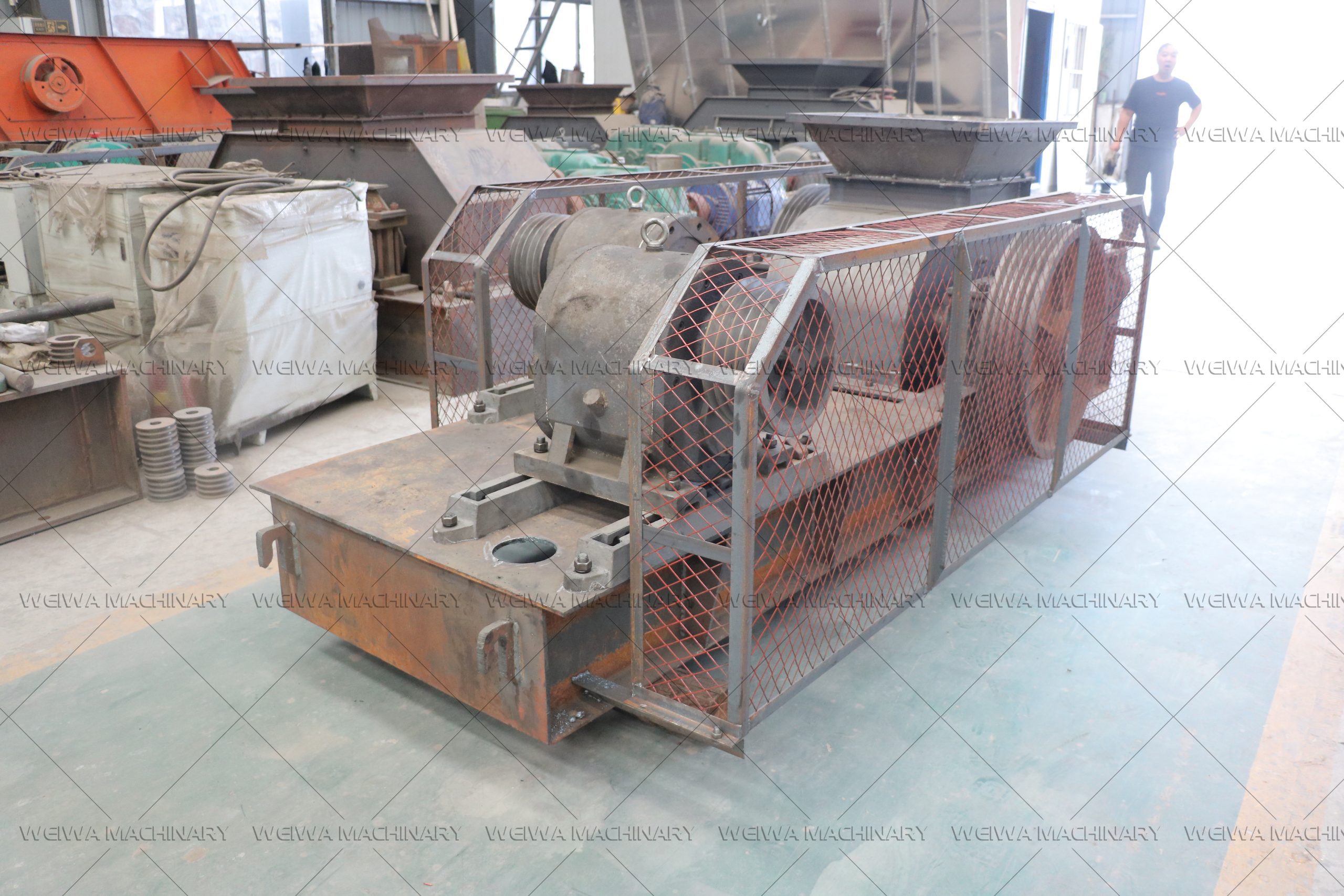
A High Strength Roll Crusher—also referred to as a double roll crusher or twin-roll crusher—crushes material by drawing it into the narrowing space between two horizontally mounted, counter-rotating rolls. The material is gripped by friction at the so-called nip angle and subjected to gradually increasing compressive stress until it fails and passes through the adjustable gap. The final product size is principally determined by the roll surface profile and the minimum center-to-center distance of the rolls, which defines the closed-side setting. Weiwa Machinery’s high strength variant differentiates itself through upgraded roll shell metallurgy, a reinforced fabricated steel frame, heavy-duty spherical roller bearings, and a drive system engineered for high torque rather than high speed.
The roll shells on our machines are manufactured from high-alloy wear-resistant steel, surface-hardened by induction or flame hardening to achieve a hardness typically in the range of HRC 55–60 on the working surface. This significantly extends service life when processing abrasive limestone, iron ore sinter, or bauxite. One roll is conventionally fixed in its bearing housing, while the opposing roll floats on spring-loaded or hydraulic mounts. If an uncrushable tramp iron enters the chamber, the floating roll yields momentarily, protecting the frame and gears from overload. After the obstruction passes, the roll returns to its preset gap position automatically. This overload protection is critical in European installations where legacy tramp metal may occasionally appear in recycled feeds.
Gap Adjustment and Drive Configuration Options
Depending on customer preference and budget, Weiwa offers mechanical gap adjustment via threaded spindles and shim packs, or fully hydraulic gap adjustment with position feedback. The hydraulic version—selected by our Italian client—allows the operator to modify the discharge opening under load, accommodating variations in feed top size or desired product curve without shutting down the circuit. Drive packages normally consist of two independently coupled electric motors, each driving one roll through a parallel-shaft reducer. Total installed power ranges from 15 kW × 2 up to 90 kW × 2 or more on large-capacity models. The low-speed, high-torque characteristic ensures smooth start-up even with a partially filled crushing chamber and avoids the peak-current spikes common with direct-on-line started impact crushers.
Model Specifications Relevant to Crusher in Italy Applications
Weiwa Machinery produces a series of High Strength Roll Crusher models designated 2PG400×250 through 2PG1200×1000 and beyond for custom projects. The numerals denote roll diameter (mm) and roll length (mm). For typical Crusher in Italy limestone secondary-crushing duties with feed up to 80–120 mm and required capacity of 30–80 t/h, models in the 2PG600×400 to 2PG800×500 range are most frequently specified. Key parameters influencing selection include anticipated feed top size, Bond abrasion index of the material, desired product d₈₀, and whether the crusher will operate in open or closed circuit with a vibrating screen.
As a reference, the 2PG800×500 model features roll diameter 800 mm, roll width 500 mm, recommended feed size ≤ 40 mm for smooth rolls or ≤ 80 mm for corrugated/toothed rolls depending on profile, discharge setting adjustable between 2–20 mm, approximate capacity 20–60 t/h on limestone (varies with gap and material density), and dual 30 kW–37 kW motors. The machine mass is approximately 5.8 tonnes excluding drive guards and platform. All models are painted to marine-grade anti-corrosion specification for overseas shipment and can be supplied with CE-marked electrical components upon request—an important consideration for any Roll Crusher for Italy installation.
Material Suitability and Roll Surface Selection
Smooth roll surfaces are optimal for fine crushing of hard, non-sticky materials such as coke, glass cullet, or dry limestone where uniform product and minimal fines are priorities. Corrugated rolls improve nip on slightly larger or more irregular feeds and introduce a limited shearing action useful for medium-hard rock. Toothed or lug-type rolls are chosen when the feed contains plastic clay, soft shale, or cohesive coal, as the teeth penetrate the material and initiate fracture prior to full compression. Specifying the correct roll surface profile for the Italian customer’s blend of limestone with intermittent clay partings was essential to prevent build-up on the roll faces and maintain rated throughput during the trial period.
Shipment Preparation and On-Site Commissioning of the Roll Crusher in Italy
Prior to export, the High Strength Roll Crusher underwent a comprehensive workshop test using limestone blocks simulating the expected feed size distribution. Roll alignment, bearing temperature rise, oil mist lubrication (where fitted), and gap calibration were verified and documented in a Factory Acceptance Test report provided to the client. The crusher body, drive units, hydraulic power pack, and spare roll segments were packed in a 20-foot flat rack container with moisture-barrier wrapping and shock-absorbing timber blocking, compliant with ocean freight requirements to the Port of Genoa.
Upon arrival, Weiwa technical engineers joined the customer remotely via video link during unloading, positioning, anchoring, and drive wiring. Particular attention was given to confirming the direction of rotation for both rolls—they must counter-rotate with the top edges moving inward—and checking the hydraulic gap readout against feeler-gauge measurements at four points across the roll face. Once the belt conveyor interface and dust encapsulation hood were aligned, the first material was introduced at reduced feed rate.
Field Trial Results and Performance Observations
During the initial eight-hour continuous run, the High Strength Roll Crusher in Italy processed run-of-quarry limestone pre-crushed to minus 100 mm at an average rate of approximately 52 t/h. The hydraulic gap was set at 18 mm initially, then narrowed to 12 mm for the second trial phase. Product samples taken at 15-minute intervals showed a d₈₀ consistently between 10–14 mm with a remarkably low proportion of minus 2 mm fines—typically under 8% by weight. This matched the customer’s objective of feeding a raw mill with narrowly graded material to optimize grinding media charge and reduce recirculation load.
Bearing temperatures stabilized at 42–46 °C after the first two hours, well within the alarm threshold. Noise level measured at one meter from the machine enclosure was below 78 dB(A), compliant with typical Italian workplace environmental norms. The only adjustment required during the trial was minor re-tensioning of the V-belt drives after the first shift, a routine maintenance task explained to the local crew. The customer expressed particular satisfaction with the ease of gap modification, which allowed them to compensate for gradual roll wear and maintain product spec without interrupting production—a practical advantage of specifying a high-strength hydraulic-roll Crusher over basic mechanical models.
Advantages of Choosing Weiwa High Strength Roll Crusher for the Italian Market
Selecting crushing equipment is rarely a decision based solely on first-cost. Italian operators weigh energy efficiency, ease of maintenance, parts interchangeability, and supplier responsiveness. Weiwa Machinery’s High Strength Roll Crusher addresses these concerns through a combination of conservative mechanical design, globally sourced branded bearings and seals, and a modular approach that allows roll shells to be replaced without dismantling the entire roll shaft assembly. Our standard documentation package includes Italian-language safety decals on request, detailed parts explosion drawings, and recommended preventive maintenance schedules aligned with typical European shift patterns.
Furthermore, our experience exporting to more than 120 countries means we routinely handle CE documentation, certificate of origin, EUR.1 movement certificates, and coordination with freight forwarders serving Mediterranean ports. For businesses seeking a Roll Crusher for Italy that balances Chinese manufacturing cost-efficiency with internationally recognized engineering practices, Weiwa offers a compelling proposition: proven double-roll technology, customizable to local material characteristics, backed by a responsive after-sales team fluent in technical English and able to liaise with Italian-speaking agents in key regions.
Customization and OEM Flexibility
Not all limestone or clay is the same, and not all plant layouts permit the same footprint. Weiwa can tailor inlet chute geometry, drive side (left or right), motor brand preference (Siemens, ABB, WEG etc.), control panel language and PLC integration, and even roll surface patterning to match a specific site’s historical wear patterns. For the Italy shipment, the inlet was modified to accept a staggered-distribution feed chute minimizing segregation of coarse versus fine fractions—a small but meaningful detail that contributed to even roll wear during the trial.
Frequently Asked Questions About Roll Crusher Installation in Italy
Is a High Strength Roll Crusher suitable as a primary crusher for Italian quarries?
Generally no. The High Strength Roll Crusher is most effective in secondary or tertiary duty after a jaw or gyratory primary crusher has reduced boulder feed to manageable top size. Attempting to feed run-of-mine boulders exceeding the nip-angle capability will cause rollback or excessive stall current. For primary crushing of large limestone blocks, we recommend our CJ or PE series jaw Crusher as the first stage, followed by the roll crusher for product shaping and fines control.
What maintenance interval should we expect?
Roll shell dressing or replacement depends heavily on abrasion index and hourly utilization. In typical limestone service with clean feed, first shell re-profile may be scheduled after 1,500–2,500 operating hours. Bearing lubrication is usually greased or oil-mist circulated on a weekly or continuous basis per the manual. The hydraulic relief system requires periodic seal inspection but seldom needs parts replacement inside the first two years if operated within rated pressure.
Can the machine be integrated with existing Italian screening circuits?
Yes. The Roll Crusher discharges centrally downward and can be positioned beneath a scalping screen oversize chute or ahead of a finished-product screen in closed circuit. We supply general arrangement drawings in DWG and PDF formats to facilitate interface design with local conveyors and support structures.
Partner with Weiwa Machinery for Your Crusher in Italy Requirement
The successful dispatch, installation, and on-site validation of our High Strength Roll Crusher in Italy reaffirm that compression crushing remains an intelligent choice for limestone, clay-bearing raw mixes, and certain recycling applications across the Italian peninsula. Uniform product size, low dust generation, adjustable gap control, and rugged high-strength construction combine to deliver measurable value in daily operation. Whether you are upgrading an existing cement raw-mill feed line, optimizing an aggregates secondary stage, or exploring a Roll Crusher for Italy to handle sticky or moist feeds that challenge impact crushers, Weiwa Machinery has the engineering know-how and export experience to support your project from inquiry through commissioning and beyond.
Contact Weiwa Machinery today to discuss model selection, receive a tailored quotation, or request the detailed brochure for our High Strength Roll Crusher series.
About Weiwa Machinery
Weiwa Machinery is a professional manufacturer and exporter of mining crushing, screening, grinding and drying equipment, headquartered in Gongyi City, Henan Province, China. With over 30 years of experience in heavy-industry machinery design and fabrication, our products—including Jaw Crusher, High Strength Roll Crusher, Hammer Crusher, Cone Crusher, sand-making lines and complete mineral beneficiation plants—have been exported to more than 120 countries and regions. We hold ISO 9001 quality management certification and routinely prepare CE-compliant documentation for European Union market entries.
Our commitment goes beyond equipment supply. Weiwa provides layout design assistance, spare parts stock recommendations, remote troubleshooting, and on-site installation support through a global network of partners. We believe in long-term cooperation built on transparent communication, reliable quality, and responsive after-sales service.
Email: [email protected]
Phone / WhatsApp: +86 18439853888
Address: Dahuangye Industrial Zone, Gongyi City, Henan Province, China